Malaysia’s e-Invoicing rollout, led by the Inland Revenue Board of Malaysia (LHDN), marks a significant shift in how businesses issue, validate, and report invoices, with professional service providers among the most directly affected. Consulting firms, marketing and digital agencies, as well as legal, advisory, and compliance professionals typically operate on service-based, milestone-driven, or retainer billing models, making accurate invoicing and timely payment critical to cash flow and client trust. Under the new e-Invoicing framework, these firms must move beyond traditional PDF or manual invoices to structured, compliant digital invoices that align with LHDN requirements. As a result, e-Invoicing should not be viewed solely as a regulatory obligation, but also as an operational upgrade that enhances billing efficiency, reduces administrative friction, and supports long-term business scalability in Malaysia’s increasingly digital economy.
Key Summary
E-Invoicing Is a Business Standard
Malaysia’s LHDN e-Invoicing framework makes structured digital invoicing mandatory for professional service firms.
Compliance and Operational Efficiency
Proper e-Invoicing improves accuracy, reduces disputes, and strengthens audit readiness.
Cash Flow Improves With Faster Validation
Early invoice validation and digital transmission help shorten payment cycles.
Operational Readiness Matters
Clean data, aligned workflows, and internal coordination are critical for successful adoption.
Early Adoption Supports Long-Term Growth
Firms that prepare early face less disruption and are better positioned in Malaysia’s digital economy.
Read: A Complete Guide To E-Invoice In Malaysia
What Is E-Invoicing Under Malaysia’s Framework?
In the Malaysian context, e-Invoicing refers to the electronic issuance and exchange of invoice data in a structured digital format that complies with requirements set by the Inland Revenue Board of Malaysia (LHDN). It is not merely a digital version of a paper invoice, but a system-driven process where invoice information is captured, transmitted, validated, and stored electronically. Under this framework, invoice data is standardised so it can be read and processed automatically by both businesses and LHDN, supporting greater transparency and tax compliance across the economy.
E-Invoicing differs fundamentally from traditional PDF or email invoices, which are largely unstructured and rely on manual review or data entry. Malaysia’s e-Invoicing system is built around structured data fields and real-time or near-real-time validation, allowing invoices to be checked against LHDN rules before they are considered valid. This applies to professional service providers such as consultants, marketing agencies, legal firms, and advisory practices, regardless of whether they bill by retainer, milestone, or hourly basis. For these businesses, e-Invoicing becomes part of their operational workflow rather than a standalone administrative task.
| Aspect | Traditional PDF / Email Invoice | LHDN E-Invoicing |
| Data format | Unstructured, human-readable | Structured, machine-readable |
| Validation | Manual or post-issuance checks | Real-time or near-real-time validation |
| Error risk | Higher due to manual handling | Lower through automated checks |
| Regulatory integration | Limited | Directly aligned with LHDN system |
| Applicability | Optional format | Mandatory for in-scope businesses |
By adopting e-Invoicing, professional service firms are required to align their billing processes with LHDN’s digital infrastructure, ensuring compliance while also improving accuracy, efficiency, and visibility over invoicing activities.
Read: 5 Types of e-Invoice in Malaysia
Why the Malaysian Government Is Moving Towards E-Invoicing
The Malaysian government’s move towards e-Invoicing is driven by the broader digitalisation of tax administration. As business transactions increasingly shift to digital platforms, the Inland Revenue Board of Malaysia (LHDN) is modernising how tax data is collected, processed, and monitored. E-Invoicing allows LHDN to receive transaction data electronically in a standardized format, reducing reliance on manual submissions and retrospective reporting while improving overall system efficiency.
A key objective of e-Invoicing is to enhance transparency through access to real-time or near-real-time transaction data. Instead of relying on periodic filings or delayed reporting, LHDN can gain earlier visibility into business activities across sectors. This improves data accuracy and enables faster identification of inconsistencies, reporting gaps, or unusual transaction patterns. For the government, this supports better revenue forecasting and more informed policy decisions.
Another important driver is the reduction of tax leakage, errors, and evasion. Manual invoicing processes are more prone to human error, duplicate records, and inconsistent reporting. By requiring structured digital invoices that are validated at the point of issuance, e-Invoicing helps minimise these risks. Automated checks reduce incorrect data submissions and strengthen compliance without increasing administrative burden for compliant businesses.
The COVID-19 pandemic also highlighted the importance of timely economic data. During periods of economic disruption, governments with access to near real-time transaction information were better positioned to design targeted support measures and respond quickly to changing conditions. This experience reinforced the value of digital tax infrastructure and accelerated Malaysia’s push towards e-Invoicing as part of long-term economic resilience planning.
| Government Objective | Role of E-Invoicing |
| Tax administration digitalisation | Automates data collection and validation |
| Greater transparency | Provides timely, standardised transaction data |
| Reduced tax leakage | Lowers errors and limits under-reporting |
| Crisis response readiness | Enables faster economic analysis and policy action |
For service-based businesses such as consultants, legal firms, and professional agencies, this shift means invoicing is no longer just an internal accounting task. Invoices become part of a broader digital reporting ecosystem connected to LHDN. While compliance is mandatory, businesses that adapt early can also benefit from clearer records, fewer billing errors, and improved cash flow visibility within Malaysia’s evolving tax framework.
Read: Malaysia E-Invoicing Models: MyInvois Portal Vs API Integration
How Professional Service Firms Benefit From E-Invoicing
For professional service firms in Malaysia, including consultants, agencies, legal practices, and advisory businesses, e-Invoicing is not only a regulatory requirement but also a practical business improvement. When implemented correctly, it supports faster payments, improves accuracy, strengthens compliance, and reduces operational costs.
1. Faster Payments and Improved Cash Flow
One of the most immediate benefits of e-Invoicing is the positive impact on payment timelines. Traditional invoicing often involves manual preparation, email delivery, and follow-ups, all of which can slow down approval and payment cycles.
With e-Invoicing, invoices are issued electronically in a structured format and transmitted through approved channels. This significantly reduces delivery delays and ensures invoices reach the right recipient promptly. In addition, invoice validation occurs early in the process, minimising rework caused by missing or incorrect information.
E-Invoicing also provides clearer visibility over invoice status. Professional firms can track whether an invoice has been issued, validated, or rejected, creating a reliable audit trail. This transparency helps finance teams follow up more effectively and improves cash flow predictability.
2. Greater Accuracy and Fewer Disputes
Billing disputes are a common challenge for professional service firms, particularly those billing by milestones, retainers, or time spent. E-Invoicing helps address this by introducing standardised invoice formats aligned with LHDN requirements.
Because invoice data follows defined structures and fields, there is less room for ambiguity. Service descriptions, amounts, and tax information are presented consistently, making invoices easier for clients to review and approve. Automated data capture also reduces reliance on manual data entry, which is a frequent source of errors in traditional invoicing.
As a result, firms experience fewer invoice rejections, fewer clarification requests from clients, and reduced time spent resolving billing disputes.
| Area | Traditional Invoicing | E-Invoicing |
| Invoice format | Varies by staff or template | Standardised and structured |
| Data entry | Manual and repetitive | Automated and system-driven |
| Error risk | Higher | Lower |
| Dispute frequency | More common | Reduced |
3. Compliance Readiness
Compliance is a key consideration under Malaysia’s e-Invoicing framework. Professional service firms are required to issue invoices that align with LHDN’s technical and data requirements, regardless of business size or service model.
E-Invoicing systems are designed to support this alignment by validating invoice data against LHDN rules before or during submission. This helps firms identify issues early, rather than discovering problems during audits or tax filings. Over time, this structured approach supports stronger compliance habits and better record-keeping.
By reducing the likelihood of rejected invoices or non-compliant documentation, e-Invoicing also lowers the risk of penalties and administrative complications. For firms operating in regulated or client-sensitive environments, this compliance readiness is particularly important.
4. Cost and Time Savings
Beyond compliance and accuracy, e-Invoicing delivers measurable operational savings. Manual invoicing processes require staff time for preparation, checking, sending, and filing invoices. These tasks can be significantly reduced through digital workflows.
E-Invoicing lowers administrative workload by automating repetitive steps and reducing back-and-forth communication caused by errors or missing information. It also eliminates many physical costs associated with paper-based invoicing, such as printing, postage, and document storage.
Over time, these efficiencies allow professional service firms to reallocate resources toward higher-value activities, such as client service, business development, and financial planning, while maintaining compliant and efficient billing operations.
Read: Malaysia E-Invoicing System: What Businesses Need to Know
E-Invoicing Use Cases For Professional Services
E-Invoicing under Malaysia’s LHDN framework is flexible enough to support the different billing models used by professional service firms. Whether services are billed hourly, on a fixed-fee basis, or through recurring arrangements, structured e-Invoices can be integrated into day-to-day operations without disrupting commercial practices.
Consulting Projects (Hourly vs Fixed-Fee Billing)
Consulting firms commonly operate on either hourly billing or fixed-fee project arrangements. E-Invoicing supports both models by allowing invoice data to clearly reflect how fees are calculated.
For hourly-based projects, service descriptions can be linked to tracked hours and agreed rates, reducing ambiguity and follow-up queries from clients. For fixed-fee engagements, milestone or project-based charges can be clearly stated in a standardised format that aligns with LHDN requirements. In both cases, structured data reduces manual entry and helps ensure invoices are validated promptly.
Retainer-Based Advisory Services
Advisory firms often issue monthly or quarterly retainer invoices for ongoing services. E-Invoicing is particularly effective in these scenarios because invoice details tend to be consistent from one period to the next.
Once the invoice structure is set up, recurring invoices can be generated with minimal adjustments. This reduces administrative effort while maintaining consistency and compliance. Clients also benefit from predictable, standardised invoices that are easier to process internally, supporting smoother approval and payment cycles.
Agencies with Recurring Monthly Invoices
Marketing, digital, and creative agencies frequently manage multiple clients on recurring monthly billing arrangements. E-Invoicing helps agencies maintain accuracy and efficiency at scale.
Structured invoice formats reduce the risk of inconsistent descriptions, missing information, or incorrect amounts across client invoices. When combined with proper record-keeping, agencies gain better visibility over issued invoices and outstanding payments, which is essential for managing cash flow across a large client base.
Legal and Compliance Services with Matter-Based Billing
Legal and compliance firms typically bill by matter, case, or engagement rather than by time alone. E-Invoicing accommodates this model by allowing matter references and service details to be captured clearly within invoice data fields.
This clarity supports both regulatory compliance and client understanding. Matter-based billing presented in a structured format also strengthens audit trails, which is important for firms operating in regulated or high-compliance environments.
Cross-Border Clients and Multi-Currency Considerations
Many Malaysian professional service firms work with overseas clients and issue invoices in foreign currencies. At a high level, e-Invoicing supports this by clearly identifying currency information and transaction values within structured invoice data.
While firms must still ensure alignment with Malaysian tax reporting requirements, having standardised invoice data makes it easier to manage cross-border transactions and maintain consistent records. This becomes increasingly important as businesses expand internationally and handle higher invoice volumes.
| Service Model | How E-Invoicing Supports It |
| Hourly consulting | Clear breakdown of hours and rates |
| Fixed-fee projects | Consistent milestone or project billing |
| Retainer services | Efficient recurring invoice generation |
| Agency billing | Standardised monthly invoices at scale |
| Legal and compliance | Structured matter-based billing |
| Cross-border work | Clear currency and transaction data |
Across these use cases, e-Invoicing provides a common foundation for compliant, efficient, and transparent billing. For professional service firms in Malaysia, this flexibility ensures that operational realities are supported while meeting LHDN e-Invoicing requirements.
Key Elements of an E-Invoice For Professional Services
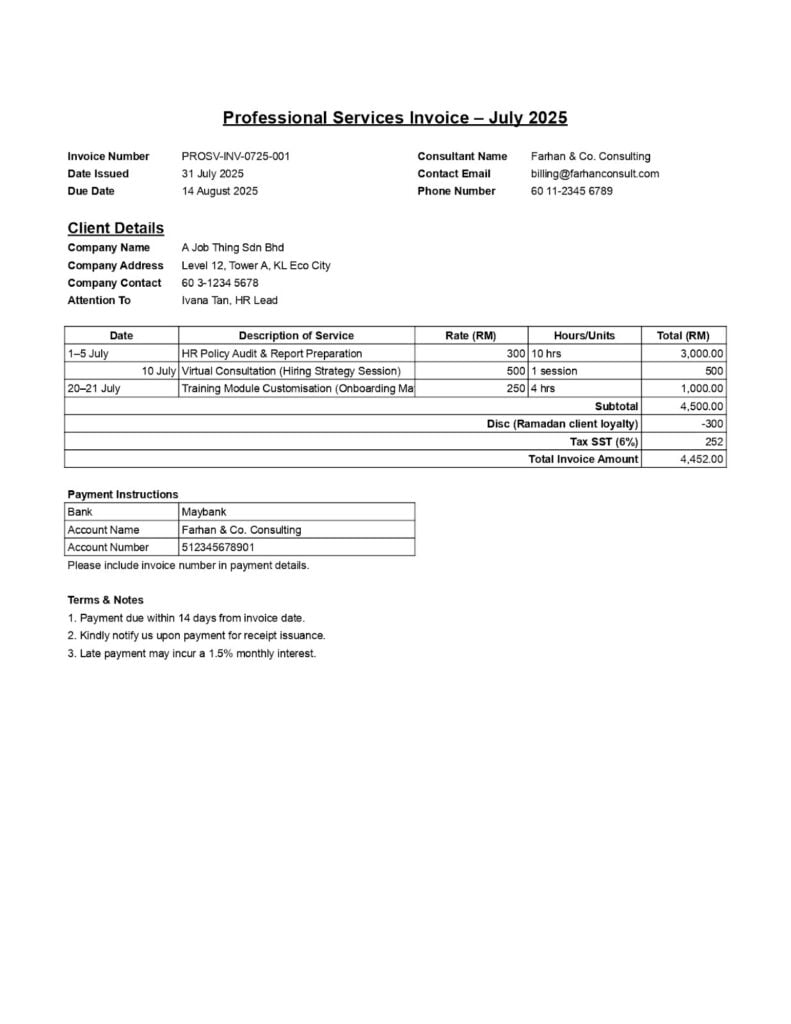
Under Malaysia’s e-Invoicing framework, professional service firms must ensure that each e-Invoice follows a defined structure and meets LHDN’s data and validation requirements. While billing models may differ across consulting, legal, and advisory services, the core invoice elements remain consistent. The focus should always be on accuracy, clarity, and compliance rather than tax planning or advisory outcomes.
1. Supplier and Client Identification Details
Every e-Invoice must clearly identify both the supplier and the client. This typically includes the legal business name, registration number, and relevant contact information. Accurate identification ensures that invoices can be matched correctly within LHDN’s system and within the client’s internal records.
For professional service firms, this is particularly important when dealing with group structures, multiple entities, or clients with centralised finance teams.
2. Unique Invoice Number and Issuance Date
A unique invoice number is a mandatory element and plays a key role in traceability and record-keeping. Each e-Invoice must have a distinct reference that is not reused.
The issuance date must also be clearly stated. This date supports compliance tracking and aligns the invoice with reporting and validation timelines under LHDN’s framework. Consistent numbering and dating practices help reduce confusion and simplify audits.
3. Clear Description of Services Rendered
Professional services are often intangible, which makes clear descriptions essential. E-Invoices should include a concise but specific description of the services provided, such as consulting work, advisory support, legal services, or compliance-related tasks.
Standardised descriptions reduce misunderstandings, support client approval processes, and lower the likelihood of invoice rejection due to unclear or incomplete information.
4. Service Period and Billing Structure
The service period covered by the invoice should be clearly indicated, especially for hourly work, retainers, or recurring services. This helps clients understand what timeframe the charges relate to and supports internal reconciliation.
The billing structure should also be evident, whether the charges are hourly, fixed-fee, milestone-based, or recurring. Clear alignment between the service period and billing method improves transparency and reduces follow-up queries.
5. Tax Information (Where Applicable)
Where tax applies, relevant tax-related fields must be completed in accordance with LHDN requirements. This includes indicating applicable tax components and ensuring consistency between taxable amounts and totals.
This section should be treated as a compliance requirement rather than tax advice. Professional service firms should focus on ensuring that invoice data is complete and accurately reflected within the e-Invoicing system.
6. Total Payable Amount
The total amount payable must be clearly stated and accurately calculated based on the services rendered and applicable charges. This includes ensuring that subtotals, tax amounts where relevant, and the final payable figure align correctly.
Clear presentation of the total payable amount supports faster client approval and reduces disputes related to calculation errors.
7. Digital Validation Requirements
A defining feature of Malaysia’s e-Invoicing framework is digital validation. Before an e-Invoice is considered valid, it must pass system checks that confirm required data fields are present and correctly formatted.
For professional service firms, this means ensuring that invoice data is complete at the point of issuance. Proper validation reduces the risk of rejected invoices, delayed payments, and compliance issues.
| Key Element | Purpose |
| Supplier and client details | Accurate identification and matching |
| Invoice number and date | Traceability and record-keeping |
| Service description | Clarity and dispute reduction |
| Service period and structure | Transparency in billing |
| Tax information | Compliance with reporting requirements |
| Total payable amount | Clear payment expectations |
| Digital validation | Acceptance under LHDN system |
By understanding and applying these core elements, professional service firms can issue e-Invoices that are structured, compliant, and aligned with LHDN expectations, while maintaining clear and professional billing practices.
Sample
Operational Changes Firms Should Prepare For
Malaysia’s e-Invoicing framework requires professional service firms to rethink how billing data flows across the organisation. For law firms, consultancies, and advisory practices, compliance is not achieved by software alone. It depends on operational readiness, internal coordination, and data discipline.
Below are the key operational changes firms should prepare for to support smooth and compliant e-Invoicing adoption.
Adjustments to Billing Workflows
Traditional billing workflows often rely on manual reviews, PDF generation, and email-based approvals. Under Malaysia’s e-Invoicing model, these steps must be streamlined and standardised.
Firms should expect changes such as:
- Earlier finalisation of billing data before invoice issuance
- Reduced tolerance for post-issuance edits or adjustments
- Closer alignment between service delivery records and invoicing timelines
For professional services billed on retainers, milestones, or hourly arrangements, this means billing processes must be clearly defined and consistently followed across all engagements.
Data Accuracy Across CRM, Accounting, and Invoicing Systems
E-Invoicing relies on structured data. Any inconsistency between systems increases the risk of invoice rejection or delays.
Professional firms typically manage client and engagement data across multiple platforms, including CRM systems, practice management tools, and accounting software. These systems must reflect the same core information to ensure accurate invoice generation.
Key data points that must remain consistent include client legal names, identification details, service descriptions, and pricing structures. Regular data reconciliation becomes an operational necessity rather than a best practice.
Internal Coordination Between Operations, Finance, and Management
E-Invoicing introduces tighter dependencies between teams. Operations teams record services, finance teams issue invoices, and management oversees compliance and risk.
Clear internal roles and responsibilities help avoid bottlenecks. For example, service teams must submit complete and accurate billing inputs on time, while finance teams must validate invoice data before submission through approved channels.
Regular communication between departments supports faster issue resolution and ensures that operational changes are implemented consistently across the firm.
Importance of Clean Master Data
Clean master data is the foundation of compliant e-Invoicing. Incomplete or outdated records can lead to repeated errors and operational friction.
The table below highlights common master data areas that require attention:
| Master Data Area | Why It Matters for E-Invoicing |
| Client records | Ensures correct identification and reduces invoice rejection risk |
| Service descriptions | Supports clarity, transparency, and structured invoice reporting |
| Pricing and fee structures | Prevents mismatches between billed amounts and agreed terms |
| Internal reference codes | Improves traceability across systems and audit readiness |
Firms should review and standardise master data before scaling e-Invoicing processes. Ongoing maintenance is equally important, especially for firms with large or recurring client bases.
Read: How To Submit Consolidated e-Invoice Via MyInvois Portal In Malaysia
Choosing The Right E-Invoicing Setup
Selecting the right e-Invoicing setup is a strategic decision for professional service firms in Malaysia. Beyond meeting regulatory requirements, the chosen approach should support daily operations, business growth, and long-term compliance. Law firms, consultancies, and advisory practices must carefully assess how e-Invoicing fits into their existing workflows and future plans.
1. Manual Portal Submission vs System Integration
Malaysia’s e-Invoicing framework allows businesses to submit invoices manually through the designated portal or through direct system integration.
Manual submission may suit firms with low invoice volumes or simple billing structures. However, it requires more hands-on effort, increases the risk of data entry errors, and can strain resources as invoice volumes grow.
System integration connects invoicing directly with accounting or practice management systems. This approach supports automation, improves data accuracy, and enables faster invoice issuance. For professional firms handling multiple clients or recurring billing, integration offers better control and operational efficiency.
| Setup Option | Best Suited For | Key Considerations |
| Manual portal submission | Small firms with low invoice volume | Higher manual effort, limited scalability |
| System integration | Growing firms and established practices | Upfront setup, stronger long-term efficiency |
2. Considerations for SMEs and Growing Professional Firms
Small and medium-sized professional firms often face resource constraints while managing increasing compliance requirements. When choosing an e-Invoicing setup, SMEs should consider not only current needs but also expected growth.
Key factors include ease of use, compatibility with existing systems, and the ability to handle higher transaction volumes without major process changes. An overly basic setup may work initially but can quickly become inefficient as the firm expands.
3. Importance of Scalability and Future Regulatory Updates
Malaysia’s e-Invoicing landscape will continue to evolve. Regulatory updates, expanded reporting requirements, and system enhancements are expected over time.
A scalable e-Invoicing setup allows firms to adapt without frequent system replacements or manual workarounds. Solutions that support updates, integrations, and configuration changes help firms stay compliant while minimising operational disruption.
Choosing a future-ready setup reduces the risk of repeated implementation costs and operational downtime.
4. Avoiding Fragmented or Short-Term Solutions
Some firms attempt to manage e-Invoicing through multiple disconnected tools, such as spreadsheets, standalone invoicing software, and manual uploads. While this may appear cost-effective in the short term, fragmented setups often create data inconsistencies and operational inefficiencies.
A consolidated approach, where invoicing aligns closely with accounting and practice management systems, provides better visibility, accuracy, and control. For professional service firms, avoiding short-term fixes helps ensure compliance, supports sustainable growth, and strengthens overall billing governance.
Common Challenges In E-Invoicing Adoption
While e-Invoicing brings clear efficiency and compliance benefits, many Malaysian professional service firms encounter practical challenges during adoption. Understanding these issues early helps firms plan a smoother transition and avoid disruption to billing and finance operations.
1. Understanding Regulatory Requirements
One of the most common challenges is interpreting LHDN’s e-Invoicing requirements correctly. The framework introduces specific rules on invoice structure, mandatory data fields, validation timelines, and submission processes. For professional firms such as consultants and law practices, billing arrangements can vary widely, including retainers, staged fees, or disbursement charges.
Misunderstanding how these billing elements translate into compliant e-Invoice data can lead to rejected invoices or reporting gaps. Firms must ensure their invoicing practices align with current LHDN specifications and that staff understand when and how e-Invoices must be issued.
2. System Readiness and Data Consistency
E-Invoicing relies heavily on accurate, standardised data. Many firms discover that their existing systems were not designed to capture information in a structured format required for e-Invoicing.
Common issues include inconsistent client records, incomplete tax-related fields, or manual billing processes that do not integrate well with accounting systems. Without clean and consistent data, e-Invoice submission can become time-consuming and error-prone.
| Area | Common Issue | Impact |
| Client master data | Incomplete or inconsistent records | Validation failures |
| Billing data | Manual or unstructured entries | Higher error risk |
| System integration | Standalone invoicing tools | Duplicate work |
Preparing systems and standardising data before implementation is essential for long-term efficiency.
3. Change Management for Teams
E-Invoicing adoption is not purely a technical exercise. It also requires changes to internal workflows and staff responsibilities. Finance teams, billing staff, and fee earners may need to adjust how invoices are prepared, reviewed, and issued.
Resistance to new processes, limited training, or unclear internal roles can slow adoption and increase mistakes. Clear communication, practical training, and well-defined procedures help teams adapt more quickly and maintain billing accuracy during the transition.
4. Ongoing Updates as Regulations Evolve
Malaysia’s e-Invoicing framework will continue to evolve as LHDN refines requirements and expands coverage. Firms that treat e-Invoicing as a one-off implementation often struggle to keep up with regulatory updates.
Ongoing monitoring, system updates, and periodic process reviews are necessary to remain compliant. Choosing scalable systems and support structures reduces the risk of repeated rework and helps professional firms adapt efficiently as e-Invoicing regulations develop.
Best Practices For Professional Firms Transitioning To E-Invoicing
A structured and well-planned approach is essential for professional firms in Malaysia adopting e-Invoicing. Law firms, consultants, and advisory practices can minimise disruption and strengthen compliance by following proven best practices aligned with LHDN requirements.
Start Preparation Early
Early preparation gives firms more flexibility to assess readiness and address gaps before e-Invoicing becomes fully embedded in daily operations. This includes understanding applicable timelines, identifying in-scope transactions, and allocating internal responsibilities.
Firms that begin early are better positioned to test systems, train staff, and refine processes without the pressure of tight compliance deadlines.
Review Existing Invoicing Templates and Processes
Traditional invoice templates often lack the structured data required for e-Invoicing. Professional firms should review how invoices are currently issued, approved, and recorded.
Key areas to review include fee descriptions, tax treatment, client identification details, and supporting documentation. Updating templates and workflows ensures invoice data can be captured accurately and consistently in a compliant format.
| Area | Traditional Practice | E-Invoicing Requirement |
| Invoice format | PDF or manual entry | Structured digital data |
| Fee description | Free-text narratives | Standardised data fields |
| Validation | Post-issuance review | Pre-or near-real-time checks |
Ensure Accounting Systems Are E-Invoice Compatible
System compatibility is a critical success factor. Accounting and billing systems must be able to generate, store, and transmit invoice data according to LHDN specifications.
Firms should assess whether their current software supports structured data output, system integration, and updates as requirements change. Where gaps exist, system upgrades or integration solutions may be required to support long-term compliance.
Maintain Proper Documentation and Internal Controls
Strong documentation and internal controls support both compliance and audit readiness. Professional firms should maintain clear records of issued e-Invoices, validation outcomes, adjustments, and cancellations.
Internal controls help ensure invoices are issued accurately, approved appropriately, and recorded consistently. This is particularly important for firms managing complex billing arrangements or multiple client accounts.
Work With Experienced Compliance and Corporate Service Providers
Navigating Malaysia’s e-Invoicing framework can be challenging without the right expertise. Working with experienced compliance and corporate service providers helps firms interpret regulatory requirements, align systems, and implement best practices efficiently.
Professional support reduces the risk of errors, ensures processes remain aligned with evolving regulations, and allows firms to focus on their core services while meeting compliance obligations confidently.
The Future of Invoicing for Professional Services in Malaysia
Malaysia’s move towards digital tax administration is reshaping how professional service firms manage billing and financial reporting. For law firms, consultants, and advisory businesses, e-Invoicing is set to redefine industry standards and operational expectations.
1. E-Invoicing as the New Standard
E-Invoicing is no longer a temporary compliance initiative. It is becoming the default invoicing method for professional services in Malaysia, driven by LHDN’s digitalisation roadmap.
As adoption expands across industries, manual and unstructured invoicing formats will gradually be phased out. Professional firms that align early with structured e-Invoicing requirements will find it easier to meet regulatory expectations and maintain consistent compliance as rules evolve.
2. Increased Automation and Data Transparency
The future of invoicing lies in automation. E-Invoicing enables invoice data to flow directly from billing systems to tax authorities and internal records with minimal manual intervention.
This shift improves data transparency across departments, reduces reconciliation issues, and lowers the risk of errors associated with manual processing. For professional firms handling complex billing arrangements, automation supports accuracy and consistency at scale.
| Aspect | Traditional Invoicing | E-Invoicing Environment |
| Data handling | Manual input and review | Automated, structured data |
| Transparency | Limited visibility | Real-time or near-real-time |
| Error risk | Higher | Reduced through validation |
3. Better Financial Visibility for Service-Based Businesses
With structured and validated invoice data, professional firms gain clearer visibility over revenue, billing status, and cash flow trends. E-Invoicing supports faster invoice issuance, improved tracking, and more reliable financial reporting.
This enhanced visibility allows management teams to make more informed decisions, forecast cash flow more accurately, and identify billing or collection issues earlier.
4. Competitive Advantage for Early Adopters
Early adopters of e-Invoicing are better positioned to adapt to future regulatory changes and client expectations. Firms that invest in compliant systems and efficient workflows now can reduce future transition costs and operational disruption.
Beyond compliance, early adoption signals professionalism, digital readiness, and strong governance. These factors can strengthen client confidence and provide a competitive edge in an increasingly regulated and digital-first professional services market.
Conclusion
E-Invoicing in Malaysia is not merely a regulatory requirement. It represents a meaningful shift in how professional service firms manage billing, compliance, and financial operations. When implemented properly, e-Invoicing improves cash flow through faster invoice validation, enhances accuracy by reducing manual errors, and strengthens professionalism in client-facing processes. Firms that prepare early face less disruption, lower compliance risk, and greater operational control. More importantly, early adoption positions professional firms for sustainable growth as Malaysia continues to advance its digital tax and business ecosystem. In this sense, e-Invoicing is both a compliance obligation and a strategic opportunity that supports long-term resilience in a digital economy.
How FastLane Group Can Help
FastLane Group supports Malaysian professional firms at every stage of their e-Invoicing journey. Our team helps businesses understand e-Invoicing requirements, assess readiness, and align invoicing processes with existing accounting systems. Our support includes guidance on system setup, process alignment, and ongoing compliance considerations as regulations evolve. Contact us today for a consultation!