Malaysia’s mandatory e-Invoicing rollout, introduced by the Inland Revenue Board of Malaysia (LHDN), marks a significant shift in how businesses issue, validate, and record invoices through the MyInvois system. While the framework applies to all industries, creative businesses face unique compliance challenges due to the nature of their work. Unlike product-based companies, creative industry players commonly deal with project-based billing, monthly retainers, milestone payments, and ad-hoc deliverables, all of which require clear service descriptions and accurate timing under e-Invoicing rules. In addition, many creative businesses regularly engage freelancers, subcontractors, collaborators, and influencers, adding further complexity to invoicing and documentation. This guide is designed to help creative professionals understand how Malaysia’s e-Invoicing requirements apply in practice and what they need to prepare for.
Key Summary
Mandatory for Creative Businesses
e-Invoicing applies to creative agencies, freelancers, and content creators once annual revenue exceeds RM1 million.
Timeline Matters
Most creative businesses fall under Phase 3 or Phase 4, with mandatory compliance starting between July 2025 and January 2026.
B2B vs B2C Rules Differ
Corporate clients require individual validated e-Invoices, while many consumer transactions may be consolidated monthly, subject to value limits.
Service Description Is Critical
Clear descriptions for retainers, milestones, campaigns, and deliverables are essential to avoid validation issues and audit risk.
Early Preparation Reduces Risk
Aligning contracts, invoicing workflows, and accounting systems early helps creative businesses transition smoothly and stay compliant.
Read: A Complete Guide To E-Invoice In Malaysia
What Is an e-Invoice In Malaysia?
An e-Invoice is a structured electronic record of a commercial transaction between a supplier and a buyer. It must be created in IRBM’s prescribed format, typically XML or JSON, and submitted to the government’s MyInvois platform for real-time validation. Once validated, the e-Invoice is assigned a unique identifier and becomes an official tax record. This requirement applies across B2B, B2C, and B2G transactions, including service-based work commonly carried out by creative agencies, freelancers, and digital professionals.
Although e-Invoices may look similar to regular digital invoices, they are fundamentally different from the PDFs traditionally issued by creative businesses. A PDF invoice is only a visual document, while an IRBM-validated e-Invoice is machine-readable and legally recognised for tax purposes. Sending a PDF alone is no longer sufficient once a business falls within the e-Invoicing mandate, as the invoice must first be validated by IRBM before it can be shared with the client.
| Aspect | Traditional PDF Invoice | IRBM-Validated e-Invoice |
| File format | PDF or image | XML or JSON |
| IRBM validation | Not required | Mandatory |
| Legal tax record | No | Yes |
| Submission method | Email or messaging apps | MyInvois Portal or API |
| Suitable for audits | Limited | Fully compliant |
A common misconception among creative businesses is that using accounting software or issuing digital PDFs automatically means compliance. In reality, only invoices submitted and validated through MyInvois qualify as e-Invoices. This applies even if the invoice layout looks identical to what creative agencies already use for services such as digital marketing, design, SEO, or social media management. Understanding this distinction is critical for creative businesses preparing for Malaysia’s mandatory e-Invoicing requirements.
Read: 5 Types of e-Invoice in Malaysia
Is e-Invoicing Mandatory For Creative Agencies And Freelancers?
Yes. e-Invoicing is mandatory for creative agencies, freelancers, and content creators in Malaysia once the prescribed revenue threshold is met. The Inland Revenue Board of Malaysia (LHDN) applies the mandate based on legal structure and annual turnover, not on the nature of creative work. As a result, marketing agencies, design studios, and independent creators are subject to the same rules as other service-based businesses.
Applicability to Different Creative Business Structures
1. Sdn Bhd creative agencies
Creative agencies incorporated as Sdn Bhd companies are required to issue e-Invoices once their annual revenue reaches the applicable threshold. This includes agencies providing digital marketing, design, branding, SEO, social media management, and media production services. Once mandated, all qualifying transactions must be validated through the MyInvois system, regardless of whether invoices are issued to businesses or individual clients.
2. Partnerships and sole proprietors
Partnerships and sole proprietorships operating creative businesses are also covered. Many small creative studios and boutique agencies fall under this category. The determining factor is not company size or number of employees, but whether annual revenue exceeds the exemption threshold. Once required to comply, these businesses must follow the same e-Invoicing rules as incorporated entities.
3. Freelancers, influencers, and content creators
Freelancers and independent creators are often surprised to learn that e-Invoicing can apply to them as well. Individuals earning income from content creation, influencer marketing, videography, photography, or digital consulting are considered to be conducting business activities. When their annual business revenue exceeds RM1 million, they are required to issue e-Invoices in the same way as larger creative firms.
Revenue Threshold and Exemption (RM1 Million)
The current exemption threshold for Malaysia e-Invoicing is RM1 million in annual revenue. Businesses and individuals below this threshold are exempt, while those above it must comply based on the rollout phase set by LHDN.
| Annual Revenue Level | e-Invoicing Status |
| Below RM1,000,000 | Exempt from e-Invoicing |
| RM1,000,000 to RM5,000,000 | Mandatory from 1 January 2026 |
| Above RM5,000,000 | Mandatory under earlier rollout phases |
Revenue is determined using audited financial statements or tax returns for the relevant Year of Assessment. Creative businesses should rely on official financial records when assessing their compliance status.
Aggregation Rules for Sole Proprietors with Multiple Income Streams
For sole proprietors, all business income must be aggregated when assessing whether the RM1 million threshold has been exceeded. This is particularly relevant in the creative industry, where income often comes from multiple sources.
For example, a sole proprietor may earn from freelance design work, content creation for brands, and influencer collaborations. Under IRBM rules, these income streams are combined to determine total annual revenue. Operating under multiple trade names or platforms does not separate the calculation for e-Invoicing purposes.
When e-Invoicing Continues Even if Revenue Drops
A critical rule for creative businesses to understand is that e-Invoicing is not optional once it becomes mandatory. If a creative agency or freelancer exceeds the RM1 million threshold and is required to implement e-Invoicing, the obligation continues even if revenue later falls below RM1 million in subsequent years.
This commonly affects creative businesses with fluctuating income, such as project-based agencies or freelancers with seasonal work. Once e-Invoicing applies, it becomes an ongoing compliance requirement rather than a temporary measure.
e-Invoicing obligations are determined by revenue and business structure. Early awareness helps agencies and freelancers prepare their invoicing processes properly and avoid compliance risks as Malaysia’s e-Invoicing mandate continues to expand.
Read: Malaysia E-Invoicing Models: MyInvois Portal Vs API Integration
Malaysia e-Invoicing Timeline For Creative Industry Businesses
Malaysia’s e-Invoicing mandate applies to creative industry businesses based on annual revenue thresholds, not business type. Design studios, digital agencies, and freelancers must therefore assess which rollout phase applies to them and plan their transition accordingly.
For most creative businesses, the critical window falls between 2025 and 2026, when e-Invoicing becomes mandatory for companies and individuals earning RM1 million and above.
Breakdown of Implementation Phases
The Inland Revenue Board of Malaysia (LHDN) has introduced e-Invoicing in four phases to allow businesses time to adapt their systems and processes.
| Phase | Mandatory Start Date | Annual Revenue | End of Relaxation Period |
| Phase 1 | 1 August 2024 | Above RM100 million | 31 January 2025 |
| Phase 2 | 1 January 2025 | RM25 million to RM100 million | 30 June 2025 |
| Phase 3 | 1 July 2025 | RM5 million to RM25 million | 31 December 2025 |
| Phase 4 | 1 January 2026 | RM1 million to RM5 million | 31 December 2026 |
Creative agencies with steady client retainers or large project values often fall under Phase 3, while smaller studios and independent professionals typically fall under Phase 4.
Timeline Examples for Creative Businesses
1. Boutique Design Studio (RM2.5 million annual revenue)
A boutique design studio generating RM2.5 million in annual revenue falls within Phase 4
- Mandatory e-Invoicing start date: 1 January 2026
- Relaxation period available until: 31 December 2026
Operationally, this studio must ensure that all invoices issued from January 2026 onward are submitted to the MyInvois system for validation. During the relaxation period, LHDN allows some flexibility while businesses stabilise internal processes, but the obligation to issue e-Invoices still applies.
2. Digital Marketing Agency (RM8 million annual revenue)
A digital marketing agency earning RM8 million annually falls under Phase 3.
- Mandatory e-Invoicing start date: 1 July 2025
- Relaxation period available until: 31 December 2025
This type of agency typically handles multiple monthly retainers, ad-hoc campaigns, and milestone billings. The shorter relaxation period means systems, workflows, and staff training must be in place well before mid-2025 to avoid operational disruption.
3. Freelance Videographer Nearing RM1 Million Threshold
A freelance videographer earning close to RM1 million annually remains exempt until the threshold is exceeded.
- Below RM1 million: No mandatory e-Invoicing
- Once RM1 million is exceeded: e-Invoicing becomes mandatory based on the applicable phase
- Once mandated: compliance continues even if revenue later drops
For freelancers with fluctuating income, early preparation is critical. Waiting until the threshold is crossed may result in rushed system changes and higher compliance risk.
The relaxation period is often misunderstood. It does not mean e-Invoicing is optional.
Instead, the relaxation period allows businesses time to:
- Fine-tune invoicing workflows
- Resolve technical or system-integration issues
- Educate staff and freelancers involved in billing
Invoices must still be generated and submitted through MyInvois during this period. Penalty enforcement is generally lighter, but non-compliance risks remain, especially for repeated or intentional failures.
For creative businesses, this period should be treated as a controlled transition phase, not a delay strategy. Proper preparation during the relaxation window significantly reduces operational stress once full enforcement begins.
Read: Malaysia E-Invoicing System: What Businesses Need to Know
Common Transaction Types in the Creative Industry
Creative industry businesses typically deal with service-based, project-driven transactions, which are fully within the scope of Malaysia’s e-Invoicing requirements once the revenue threshold is met. While the commercial substance differs from traditional trading businesses, the e-Invoice structure remains largely consistent, provided that service descriptions, timing, and counterparties are recorded accurately.
This section outlines the most common creative transactions that require e-Invoices, explains how B2B and B2C scenarios differ in practice, and highlights situations where self-billed e-Invoices may apply, particularly for cross-border arrangements.
Typical Creative Services That Require e-Invoices
Once e-Invoicing is mandatory for a creative business, almost all income-generating services must be supported by validated e-Invoices, regardless of whether the work is project-based, recurring, or ad hoc.
The most common examples include:
| Creative Service Type | Typical Billing Structure | e-Invoicing Consideration |
| Digital marketing campaigns | Campaign-based or milestone billing | Clear campaign scope and period required |
| SEO services | Monthly retainers or fixed packages | Service period must be stated accurately |
| Graphic and UI/UX design | Project-based deliverables | Description should reflect design scope |
| Video production and photography | Per project or per shoot | Can be invoiced by project phase |
| Content creation and copywriting | Per article, package, or retainer | Itemisation by service is recommended |
| Social media management | Monthly management fees | Monthly service period should be specified |
From an e-Invoicing perspective, these transactions do not require special formats. They follow the same core requirements as other service invoices, including supplier details, buyer details, service description, value, tax treatment, and submission to MyInvois for validation.
What matters most for creative businesses is ensuring that service descriptions are commercially accurate and consistent with contracts, proposals, or statements of work.
B2B vs B2C Scenarios in Creative Work
Creative businesses frequently serve both corporate clients and individual consumers, making it important to distinguish between B2B and B2C e-Invoicing scenarios.
B2B Creative Transactions
In a B2B setting, such as an agency billing a corporate client:
- An individual e-Invoice is required for each transaction
- Buyer details, including Tax Identification Number (TIN), must be captured
- The validated e-Invoice can be used by the buyer for tax substantiation
Examples include marketing agencies, billing companies, design studios invoicing brands, or production houses invoicing corporate clients.
B2C Creative Transactions
For B2C transactions, such as freelancers or studios billing individual consumers:
- An e-Invoice is still required from the supplier’s side
- If the customer does not request an e-Invoice, transactions may be consolidated into a monthly consolidated e-Invoice, subject to IRBM rules
- If the customer requests an e-Invoice, individual buyer details must be obtained and submitted
This commonly applies to content creators, photographers, or freelance designers working directly with individuals.
When Self-Billed e-Invoices May Apply
Self-billed e-Invoices are particularly relevant in the creative industry’s cross-border and platform-based arrangements.
A creative business in Malaysia may be required to issue a self-billed e-Invoice when it incurs an expense but does not receive a compliant e-Invoice from the supplier. Common scenarios include:
- Payments to overseas platforms for advertising, creative tools, or digital services
- Fees paid to foreign freelancers or collaborators without Malaysian tax presence
- Cross-border services where the foreign supplier does not issue an IRBM-compliant e-Invoice
In these cases, the Malaysian buyer issues a self-billed e-Invoice to document the expense for tax and compliance purposes. This is particularly relevant for digital agencies relying on foreign software, stock media platforms, or international talent.
Key Practical Point For Creative Businesses
While creative transactions may feel informal or flexible in practice, e-Invoicing requires formal consistency. Each service must be properly described, timed correctly, and matched to the right transaction type. Early alignment between contracts, billing practices, and e-Invoicing processes helps creative businesses reduce compliance risks as enforcement tightens.
For creative agencies and freelancers with mixed local and overseas arrangements, identifying which transactions require normal e-Invoices versus self-billed e-Invoices is an essential part of e-Invoicing readiness.
e-Invoice Sample Structure For Creative Agencies
For creative agencies, the e-Invoice format under Malaysia’s MyInvois system is largely similar to standard service invoices. The key difference lies in how creative services are described and structured. Clear item descriptions, proper billing periods, and accurate project references are essential to ensure compliance and reduce validation or audit risks.
This section explains the key e-Invoice fields most relevant to creative services, how different creative billing models should be listed, and the common mistakes creative firms should avoid.
Key Fields Relevant to Creative Services
Creative agencies often work on campaigns, projects, or retainers rather than simple one-off services. This makes certain e-Invoice fields particularly important.
1. Service Description
The service description field should clearly reflect the commercial substance of the work performed. Descriptions should align with contracts, proposals, or statements of work.
Good practice includes:
- Stating the nature of the service, such as digital marketing, design, or content production
- Referencing the scope or deliverable, rather than vague terms like “professional fees”
- Avoiding overly generic or internal shorthand descriptions
Clear descriptions help support income recognition and reduce follow-up queries during reviews or audits.
2. Project Name vs Campaign Name
Creative agencies often use both internal project names and client-facing campaign names. For e-Invoicing purposes:
- Use the client-recognised project or campaign name where possible
- Ensure the name matches supporting documents issued to the client
- Avoid internal codes that have no external reference
Consistency across invoices, contracts, and reports improves clarity and traceability.
3. Billing Period for Retainers
For monthly retainers, the billing period should always be stated. This is especially important for services such as SEO, social media management, or ongoing digital marketing support.
Examples of acceptable formats include:
- “SEO retainer services for March 2026”
- “Social media management services for period 1–31 March 2026”
Stating the service period helps distinguish recurring income from one-off project fees.
4. Milestone-Based Invoicing
For larger creative projects, it is common to invoice based on milestones. Each milestone should be clearly identified in the service description.
For example:
- “Brand identity development – concept approval milestone”
- “Video production project – post-production phase”
Each milestone should correspond to the agreed project structure and payment schedule.
How to List Common Creative Billing Models
Creative agencies typically use a mix of bundled services, retainers, and one-off deliverables. These can all be structured clearly within a compliant e-Invoice.
| Billing Type | Recommended Listing Approach |
| Bundled services | Single line item with a clear summary of included services |
| Monthly retainers | One line item per month with stated service period |
| One-off deliverables | One line item per deliverable or project phase |
Bundled Services
For bundled offerings, such as a digital marketing package that includes ads management, content creation, and reporting, it is generally acceptable to list them as one consolidated line item, provided the description clearly summarises the scope.
This avoids unnecessary complexity while remaining compliant.
Monthly Retainers
Monthly retainers should be listed as a single recurring service, with the billing period clearly indicated. Avoid combining multiple months into one item unless contractually agreed and properly described.
One-Off Creative Deliverables
One-off services, such as logo design, website development, or a single video production, should be listed based on the specific deliverable or project stage. This improves clarity and aligns the invoice with the actual work completed.
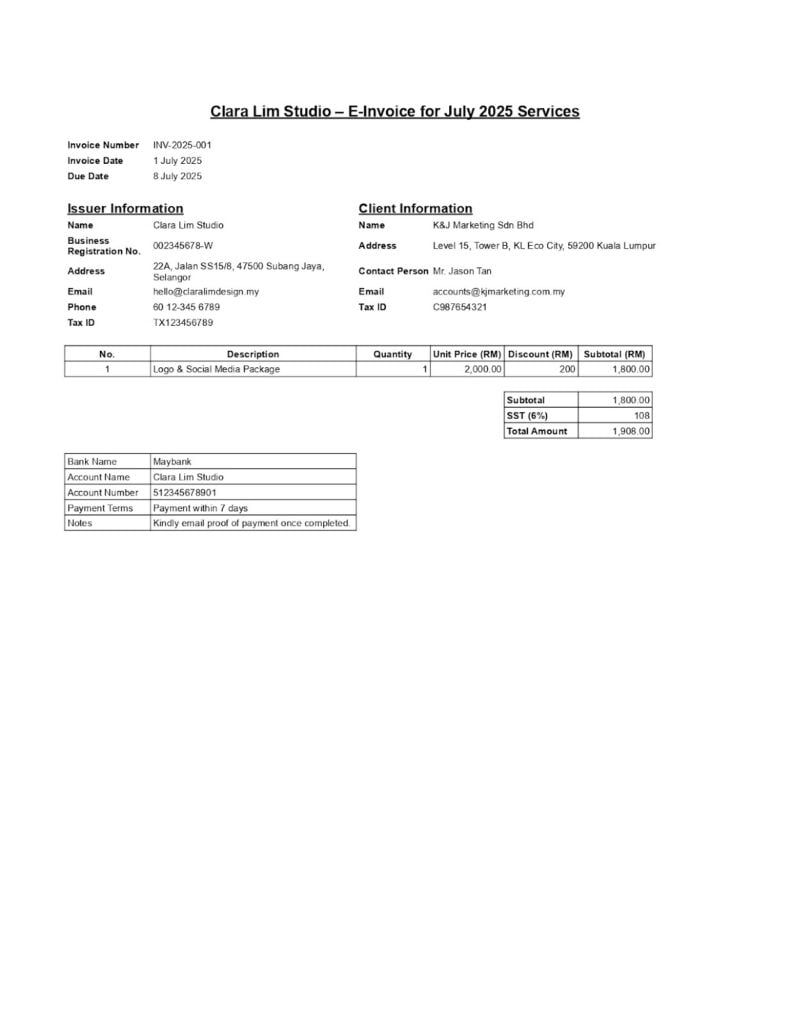
Sample 1
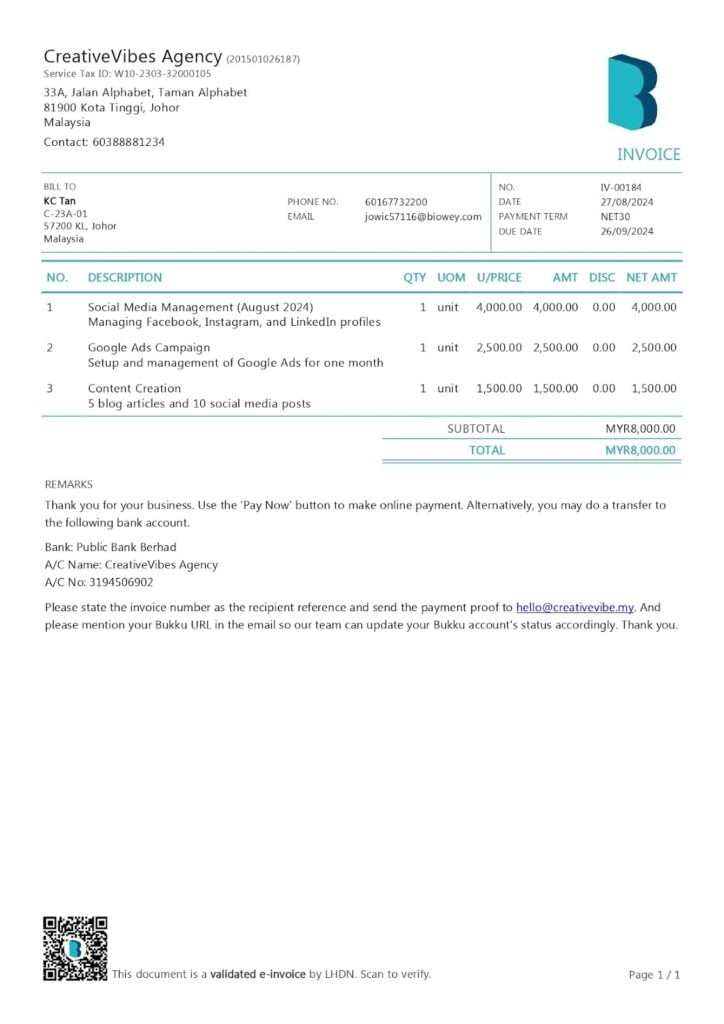
Sample 2
How Creative Businesses Handle B2B vs B2C e-Invoicing
Creative businesses in Malaysia often deal with a mix of corporate clients and end consumers, which means e-Invoicing obligations can differ depending on whether a transaction is B2B or B2C. Understanding these differences is critical to ensure compliance with LHDN requirements while keeping billing operations practical and efficient.
This section explains how creative agencies, studios, and individual creators should approach e-Invoicing for B2B and B2C work, focusing on validation rules, client data requirements, and common operational scenarios.
1. B2B Creative Projects
B2B transactions are the most structured from an e-Invoicing perspective. For creative businesses, these typically include work for companies, brands, agencies, and corporate groups.
1.1 Client TIN Requirements
For all B2B creative projects, the client’s Tax Identification Number (TIN) is mandatory. This applies regardless of whether the project is a one-off campaign, a milestone-based design project, or a monthly retainer.
Creative businesses must ensure:
- The correct legal entity name matches the client’s tax records
- The TIN provided is valid and up to date
- Client details are captured before invoice issuance to avoid rejection
Without accurate client TIN details, the e-Invoice will fail validation under the MyInvois system.
1.2 Validation and QR Code Sharing
Once a B2B e-Invoice is submitted and validated by LHDN:
- A Unique Identifier Number is issued
- A QR code is generated as part of the validated e-Invoice
Creative businesses are required to share the validated e-Invoice with their corporate clients. In practice, this usually means providing a human-readable version such as a PDF that includes the QR code, allowing the client to verify the invoice status through the MyInvois portal.
This step is especially important for agencies whose clients need e-Invoices for their own tax substantiation.
1.3 Rejection or Amendment Window (72 Hours)
B2B e-Invoices are subject to a 72-hour rejection or cancellation window starting from the time of validation.
Within this period:
- The buyer may request rejection if details are incorrect
- The supplier may cancel the e-Invoice with proper justification
After the 72-hour window, changes can no longer be made directly. Any corrections must be handled through credit notes or debit notes, which adds administrative work. For creative agencies handling high volumes of invoices, accuracy at the first submission is therefore essential.
2. B2C Creative Work (End Consumers)
B2C transactions are common for freelancers, content creators, and studios providing services directly to individuals. While e-Invoicing is still mandatory once a business is within scope, LHDN allows more flexibility in how these invoices are issued.
If an end consumer does not request an individual e-Invoice, creative businesses may consolidate multiple B2C transactions into a monthly consolidated e-Invoice.
This approach is commonly used for:
- High-volume, low-value transactions
- Individual clients who only require a receipt
- Online sales of creative packages or standard services
The consolidated e-Invoice must be submitted for validation within seven calendar days after month-end. This method helps creative businesses reduce administrative workload without breaching compliance rules.
The table below illustrates how common B2C creative scenarios are treated under e-Invoicing rules:
| Scenario | e-Invoicing Treatment |
| Content creator selling standard packages to individuals | Monthly consolidated e-Invoice allowed if no individual request |
| Content creator selling a RM15,000 personalised campaign | Individual e-Invoice mandatory from 1 Jan 2026 |
| Designer providing logo and branding services to personal brand clients | Individual e-Invoice required if client requests or value exceeds RM10,000 |
| Photographer offering multiple small shoots to individuals | Monthly consolidation generally permitted |
2.1 Content Creator Selling Packages to Individuals
A content creator selling social media or video packages to individual clients can usually rely on monthly consolidated e-Invoices, provided each transaction is below RM10,000 and no individual e-Invoice is requested.
However, once package values increase or clients require formal tax documentation, individual e-Invoicing becomes compulsory.
2.2 Design Services for Personal Branding Clients
Designers working with influencers, consultants, or professionals on personal branding projects often deal with higher-value, customised work. If the total fee exceeds RM10,000 from 1 January 2026, the designer must issue an individual e-Invoice, even though the client is not a company.
This makes early client communication important, especially when onboarding personal branding projects.
Read: How To Submit Consolidated e-Invoice Via MyInvois Portal In Malaysia
Choosing The Right e-Invoicing Model for Creative Businesses
Malaysia’s e-Invoicing framework allows businesses to choose how e-Invoices are generated and transmitted to LHDN’s MyInvois system. For creative businesses, selecting the right model is not just a compliance decision. It directly affects workflow efficiency, scalability, and data accuracy as the business grows.
There are two main e-Invoicing models available. Each suits a different stage of a creative business lifecycle.
Option 1: MyInvois Portal
The MyInvois Portal is LHDN’s government-hosted platform that allows businesses to generate and submit e-Invoices manually or via spreadsheet uploads. This option is generally appropriate for:
- Freelancers providing creative or digital services
- Small studios with limited invoicing needs
- Businesses with low transaction volume and simple billing structures
For solo designers, photographers, videographers, or content creators issuing only a handful of invoices per month, the MyInvois Portal can be a practical starting point.
Invoices are created directly in the portal or uploaded in bulk using a predefined format. Once submitted, they are validated in real time, and a QR code is generated for sharing with clients. For freelancers and small studios, this approach mirrors traditional invoicing closely, with the added step of real-time validation.
Limitations for Growing Agencies
While suitable at an early stage, the MyInvois Portal has limitations for creative businesses that are scaling. Common challenges include:
- Manual data entry increases the risk of errors
- Limited efficiency when handling recurring retainers or multiple projects
- Operational strain as invoice volumes increase
For creative agencies managing multiple clients, campaigns, and monthly retainers, reliance on manual submission can quickly become inefficient.
Option 2: API Integration with Accounting Software
API integration allows a business’s accounting or billing system to connect directly to the MyInvois system. e-Invoices are generated, submitted, validated, and tracked automatically.
This model is widely used by larger and more established creative businesses. API integration is typically recommended for:
- Marketing agencies with recurring retainers
- Media companies managing high-volume billing
- Creative agencies issuing frequent B2B and B2C e-Invoices
This setup is particularly effective for businesses that already use accounting software to manage invoicing, revenue tracking, and reporting.
With API integration:
- Invoices are generated directly from accounting records
- Validation happens automatically in real time
- QR codes and validation statuses are tracked centrally
This reduces administrative workload and improves consistency, especially for agencies issuing dozens or hundreds of invoices each month.
Importance of Clean Service Categorisation and Data Accuracy
API integration does not eliminate compliance responsibility. It increases the importance of clean data and proper service categorisation.
Creative businesses must ensure:
- Service descriptions accurately reflect the nature of work performed
- Retainer periods, milestones, and project names are clearly defined
- Client and buyer details are consistently maintained
Errors in service categorisation or master data can lead to validation failures or downstream compliance issues at scale.
Quick Comparison for Creative Businesses
| Factor | MyInvois Portal | API Integration |
| Setup cost | Low | Higher upfront |
| Transaction volume | Low | Medium to high |
| Manual effort | High | Minimal |
| Scalability | Limited | Strong |
| Best for | Freelancers, small studios | Agencies, media companies |
Takeaway for Creative Businesses
There is no single “best” e-Invoicing model for all creative businesses. Freelancers and small studios may start comfortably with the MyInvois Portal, while agencies handling multiple clients and recurring projects benefit significantly from API integration.
The key is choosing a model that matches current operations while supporting future growth, without compromising data accuracy or compliance under Malaysia’s e-Invoicing mandate.
Preparation Checklist for Creative Agencies
Proper preparation is the difference between a smooth transition and ongoing compliance issues under Malaysia’s e-Invoicing mandate. Creative agencies deal with diverse services, mixed client types, and flexible billing models, which makes early planning especially important.
The checklist below focuses on practical steps creative agencies should complete before their mandatory implementation date.
1. Review Service Descriptions and Invoicing Formats
Creative services such as digital marketing, design, SEO, content creation, and social media management must be clearly described in e-Invoices. Vague or inconsistent descriptions increase the risk of validation issues and audit queries.
Agencies should:
- Standardise service descriptions across contracts, invoices, and accounting records
- Clearly distinguish retainers, campaigns, milestones, and ad-hoc work
- Ensure invoicing formats align with MyInvois data field requirements
This review should be completed early, as changes to service descriptions often affect multiple systems and documents.
2. Identify B2B vs B2C Clients
Correctly identifying client types is critical because B2B and B2C e-Invoicing follow different operational rules.
Creative agencies should map:
- Corporate clients that require individual validated e-Invoices
- End consumers who may not request e-Invoices
- Transactions eligible for monthly consolidated B2C e-Invoices
Misclassification can lead to missing e-Invoices or improper consolidation, both of which increase compliance risk.
3. Decide Between MyInvois Portal or API Integration
The choice of e-Invoicing model directly impacts efficiency and scalability.
A practical assessment should consider:
- Monthly invoice volume
- Number of recurring retainers
- Internal administrative capacity
The table below provides a high-level guide for creative agencies.
| Business Profile | Recommended Model |
| Freelancers, small studios | MyInvois Portal |
| Growing agencies | Hybrid approach |
| High-volume agencies | API integration |
Agencies expecting growth should avoid short-term decisions that limit scalability later.
4. Train Admin and Finance Teams
e-Invoicing introduces new processes, timelines, and controls. Admin and finance teams must understand more than just how to issue invoices.
Training should cover:
- Real-time validation and rejection timelines
- Credit note and debit note procedures
- Data accuracy and internal review controls
Well-trained teams reduce errors, rework, and dependency on last-minute fixes.
5. Coordinate with Accountants Early
e-Invoicing affects bookkeeping, tax filings, and audit readiness. Coordination with accountants should start well before go-live.
Early engagement helps to:
- Align e-Invoice data with accounting records
- Address revenue timing and documentation issues
- Identify cross-border or self-billing obligations
For creative agencies, early coordination avoids misalignment between commercial invoicing practices and statutory reporting requirements.
Conclusion
Malaysia’s e-Invoicing framework has reshaped how businesses issue, validate, and record transactions, with mandatory adoption now extending to nearly all commercial activities based on revenue thresholds. Throughout this guide, we have covered what e-Invoicing is, who must comply, the phased implementation timeline, transaction types, exemptions, operational models, and practical considerations across industries. From freelancers and tuition centres to motor vehicle dealers and creative agencies, the underlying requirements remain consistent, even though invoicing practices may differ. The key takeaway is clear. e-Invoicing is no longer a future consideration but an active compliance obligation, and businesses that prepare early by aligning processes, systems, and documentation will face fewer disruptions and compliance risks over time.
How FastLane Group Can Help
FastLane Group supports clients at every stage of their e-Invoicing journey. Our team helps businesses understand e-Invoicing requirements, assess readiness, and align invoicing processes with existing accounting systems. Our support includes guidance on system setup, process alignment, and ongoing compliance considerations as regulations evolve. Contact us today for a consultation!