



Bank and regulatory scrutiny in Hong Kong continues to intensify as financial institutions strengthen KYC and compliance standards. Before banks, investors, or professional counterparties proceed, companies are increasingly required to demonstrate who controls the business and who is authorised to act on its behalf. As a result, authority and legitimacy verification has become a practical requirement in day-to-day corporate operations—especially for bank account opening, cross-border transactions, and periodic compliance reviews.
This guide explains what a Certificate of Incumbency is in a Hong Kong context, why it is commonly requested, what it typically includes, and how to obtain and maintain it properly.
Key Takeaways
What Is a Certificate of Incumbency?
A Certificate of Incumbency confirms a Hong Kong company’s current directors, officers, and authorised signatories.
Why It Matters
Commonly required for bank KYC, compliance checks, and verifying corporate authority locally and overseas.
Who Can Issue
Typically prepared and certified by independent regulated professionals—TCSP-licensed providers, solicitors, notaries (and in some cases CPAs, subject to recipient acceptance).
When to Use
Frequently requested for account opening, financing, M&A, onboarding regulated professionals, and cross-border activity.
Best Practices
Keep records current and re-issue after any change in directors, company secretary, or authorised signatories.
What Is a Certificate of Incumbency in Hong Kong?
A Certificate of Incumbency (COI) is a formal corporate document used to confirm a Hong Kong company’s current management and authorised representatives. From a governance and compliance perspective, it provides a clear record of who has authority to act on behalf of the company, based on appointments and authorisations made under the company’s Articles of Association and internal governance records.
Key aspects of a Certificate of Incumbency include:
- Authority verification: It enables banks and third parties to confirm that the individuals dealing with them are properly authorised to represent the company.
- Not a statutory filing: A COI is not a mandatory document filed with the Hong Kong Companies Registry.
- Practical necessity: While not required by Hong Kong law, it is commonly required by banks, investors, and regulated firms as part of due diligence.
- International naming: In other jurisdictions, it may be referred to as a Secretary’s Certificate, Certificate of Officers, or a certified Register of Directors (the function is similar: confirming authority and incumbents).
Why Is a Certificate of Incumbency Important for Hong Kong Companies?
A Certificate of Incumbency plays an important role in supporting corporate compliance and day-to-day business operations in Hong Kong. While it is not a statutory requirement, it is widely relied on by banks, professional firms, and overseas counterparties to verify corporate authority and reduce compliance risk.
Key reasons a Certificate of Incumbency is important include:
- Corporate transparency and governance assurance
It provides a clear and up-to-date record of the company’s current directors, officers, and authorised signatories. This supports good corporate governance by demonstrating that management appointments and signing authority are properly documented. - Bank and financial institution compliance requirements
Banks in Hong Kong commonly request a Certificate of Incumbency when opening accounts, conducting KYC reviews, or processing higher-risk transactions. It helps financial institutions confirm who is authorised to operate accounts and sign banking documents. - Support for third-party due diligence and KYC
Lawyers, auditors, payment service providers, and investors often rely on a Certificate of Incumbency as part of their due diligence process. The document provides independent confirmation of the company’s structure and authority, reducing reliance on internal declarations alone. - Reliance in contracts, transactions, and overseas dealings
A Certificate of Incumbency is frequently used in major contracts, mergers and acquisitions, fundraising, and cross-border transactions. Overseas counterparties, in particular, may require it when Hong Kong public registry information is not easily accessible or needs formal certification.
When Do Hong Kong Companies Need a Certificate of Incumbency?
Hong Kong companies typically need a Certificate of Incumbency whenever third parties require formal confirmation of corporate authority, management structure, and signing powers. Although it is not a statutory filing, it is widely requested in both local and cross-border business activities.
Corporate bank account opening and maintenance
Banks often request a Certificate of Incumbency when opening a new corporate account to verify authorised signatories, directors, and key officers. It may also be required when adding new signers or updating account mandates.
Ongoing KYC and periodic bank reviews
Hong Kong banks regularly conduct KYC refresh exercises. During these reviews, companies may be asked to provide an updated Certificate of Incumbency to confirm that management and ownership details remain accurate.
Loan, financing, and fundraising activities
When applying for bank loans, credit facilities, or raising funds from investors, lenders and investors rely on a Certificate of Incumbency to confirm who has authority to negotiate and sign binding documents.
Mergers, acquisitions, and major contracts
In M&A transactions or significant commercial agreements, counterparties often request a Certificate of Incumbency as part of legal due diligence. It provides assurance that the individuals signing on behalf of the company are properly authorised.
Professional service onboarding
Lawyers, auditors, payment service providers, and other regulated professionals may request a Certificate of Incumbency during onboarding to satisfy internal compliance and regulatory requirements.
Cross-border and overseas business transactions
Overseas banks, partners, and regulators frequently request a Certificate of Incumbency, sometimes notarised, especially where Hong Kong public registry searches are not easily accessible or accepted.
Immigration or visa-related corporate matters
For employment visas or immigration applications involving company-sponsored staff, authorities or advisers may request a Certificate of Incumbency to confirm the company’s authorised representatives and management structure.
What Information Does a Certificate of Incumbency Usually Include?
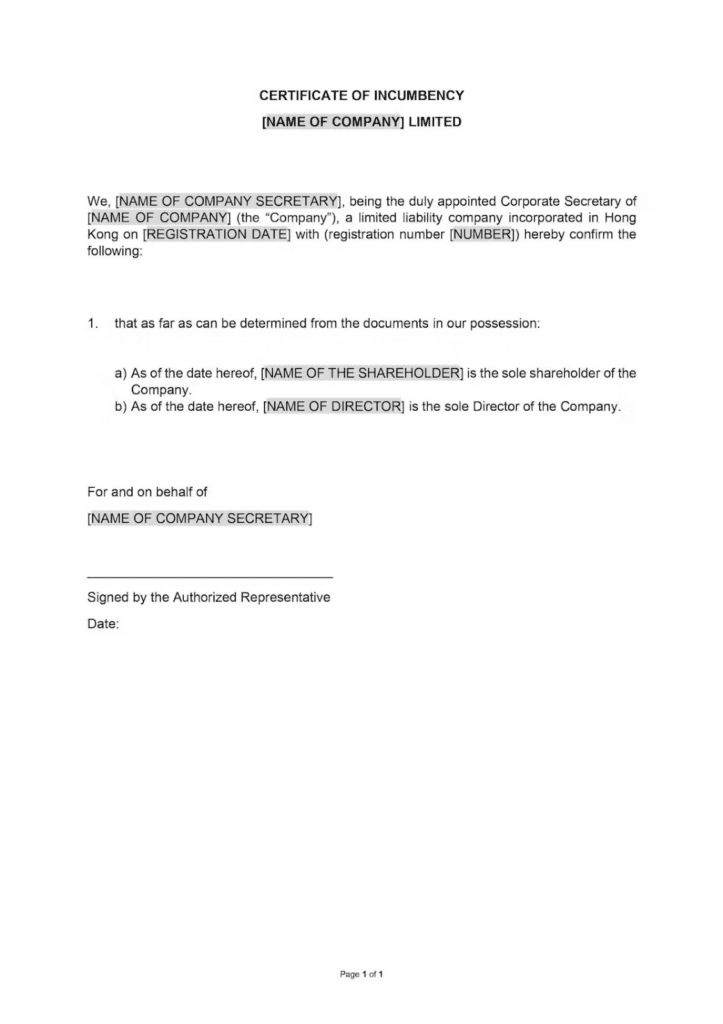
A Certificate of Incumbency does not follow a statutory template in Hong Kong. However, banks, professional firms, and overseas counterparties generally expect certain core information to confirm a company’s identity, management, and authority. The exact content may vary depending on the purpose and the requesting party.
A typical Certificate of Incumbency for a Hong Kong company includes the following details:
- Company name and Business Registration Number (BRN)
The full legal name of the company is registered in Hong Kong, together with its Business Registration Number (BRN) or company number for identification purposes. - Date and place of incorporation
Confirmation of when the company was incorporated and that it is incorporated in Hong Kong. - Registered office address
The company’s registered address in Hong Kong as recorded in its statutory filings. - Directors and senior officers
A list of current directors and key officers, including their names, positions, and dates of appointment. - Company secretary
Details of the appointed company secretary, who is typically the authorised issuer of the Certificate of Incumbency. - Authorised signatories and scope of authority
Identification of individuals authorised to sign documents or act on behalf of the company, sometimes supported by specimen signatures or a description of their signing powers. - Share capital summary
A high-level overview of the company’s authorised and issued share capital, without disclosing unnecessary ownership details. - Shareholders or members (only if specifically requested)
Shareholder information is not always included. Shareholders are usually listed only when explicitly requested. Beneficial ownership is recorded separately in the Significant Controllers Register and is not automatically disclosed through this certificate. - Issuer’s declaration, signature, and date
A formal declaration by the issuing party, usually the company secretary or a professional service provider, confirming the accuracy of the information, together with the signature and issuance date.
Who Should Be Listed on a Certificate of Incumbency?
A Certificate of Incumbency should clearly identify only those individuals who have legal authority or governance responsibility within the company. The purpose is to allow banks and third parties to confirm who can validly act on behalf of the Hong Kong company.
The following parties are typically listed on a Certificate of Incumbency:
- Directors
All current directors are usually included, as they are responsible for the company’s overall management and decision making under the Articles of Association. - Senior management or officers
Key officers, such as managing directors or chief executives, may be listed where they hold delegated authority to bind the company in operational or contractual matters. - Authorised signatories
Individuals who are authorised to sign bank documents, contracts, or other legally binding instruments are often highlighted, sometimes with a description of their signing authority. - Company secretary
The company secretary is commonly listed, as this role is responsible for maintaining statutory records and issuing the Certificate of Incumbency.
The names and roles shown in the Certificate of Incumbency must align with the company’s Articles of Association, board resolutions, and internal authorisation records. Any mismatch between the certificate and actual signing authority can lead to bank rejections, compliance delays, or challenges to contract validity.
Who Can Issue a Certificate of Incumbency in Hong Kong?
In Hong Kong, a Certificate of Incumbency must be issued by an independent and regulated professional. Banks and counterparties rely on the credibility of the issuer to ensure the information is accurate and based on proper statutory records. Commonly accepted issuers are as follows.
TCSP-licensed company secretaries
Trust or Company Service Providers licensed under the Anti-Money Laundering and Counter-Terrorist Financing Ordinance (Cap. 615) are among the most common issuers. They are authorised to maintain company records and certify corporate information.
Hong Kong solicitors
Practising solicitors may issue a Certificate of Incumbency as part of legal or transaction-related work, particularly for corporate deals or cross-border matters.
Certified Public Accountants (CPAs)
Practising CPAs may issue Certificates of Incumbency where they are engaged in a professional capacity to review and certify corporate records, subject to acceptance by the requesting bank or counterparty.
Notaries public
Notaries are often involved where the Certificate of Incumbency is intended for overseas use and may be combined with notarisation or further legalisation.
Why banks prefer independent, regulated professionals
Banks require Certificates of Incumbency to be issued by third parties who are professionally regulated and independent from day-to-day company management. This reduces the risk of inaccurate or self-declared information and supports robust KYC and compliance checks.
Common misconceptions about government issuance
A Certificate of Incumbency is not issued by the Hong Kong Companies Registry or any government authority. While public documents such as a Company Particulars Report can be obtained from the Companies Registry, they serve a different purpose and do not replace a professionally issued Certificate of Incumbency in many banking and transaction scenarios.
Certificate of Incumbency vs Other Hong Kong Corporate Documents
Hong Kong companies are often asked to provide different corporate documents for banking, compliance, or transaction purposes. Understanding the differences helps avoid delays and rejected applications.
Certificate of Incumbency vs Company Particulars Report
A Certificate of Incumbency is a professionally certified document that confirms who currently controls and can represent the company. It focuses on authority and management verification.
A Company Particulars Report is a public record issued by the Companies Registry. It shows information filed with the registry, such as directors, company secretary, and share capital. For private companies, it may also show the latest shareholders on file.
Key differences include:
- A Certificate of Incumbency is issued by an independent professional, while a Company Particulars Report is generated from public registry data.
- A Certificate of Incumbency confirms current authority and signing powers, while a Company Particulars Report does not verify who can bind the company.
- Banks may accept a Company Particulars Report for lower-risk cases, but often require a Certificate of Incumbency for full KYC reviews.
Certificate of Incumbency vs Certificate of Good Standing
A Certificate of Good Standing, also known as a Certificate of Continuing Registration, confirms that the company is properly registered and has not been struck off.
Key distinctions are:
- A Certificate of Good Standing proves the company’s legal existence, not who manages or represents it.
- A Certificate of Incumbency focuses on directors, officers, and authorised signatories.
- For cross-border transactions, banks may request both documents to confirm existence and authority.
Public registry records vs certified confirmations
Public registry records provide basic corporate information but do not involve professional verification. Certified documents, such as a Certificate of Incumbency, rely on an independent professional’s review of statutory records and internal authorisations, which offers a higher level of assurance.
When banks may accept alternatives
Some banks may accept a Company Particulars Report instead of a Certificate of Incumbency for simple account setups or periodic reviews. However, for higher-risk cases, overseas transactions, or complex ownership structures, banks typically insist on a Certificate of Incumbency issued by a regulated professional.
| Document | Issuer | What It Confirms | Typical Use |
| Certificate of Incumbency | TCSP, solicitor, CPA, notary | Current directors, officers, and signing authority | Banking KYC, contracts, cross-border transactions |
| Company Particulars Report | Companies Registry | Publicly filed corporate information | Basic bank onboarding, reference checks |
| Certificate of Good Standing | Companies Registry | Company is active and compliant | Overseas use, transaction support |
How To Obtain a Certificate of Incumbency in Hong Kong
Obtaining a Certificate of Incumbency in Hong Kong is a structured process that relies on accurate company records and professional certification. Following the steps below helps ensure the document is accepted by banks and counterparties without delay.
Step 1: Ensure statutory and internal records are up to date
Before requesting a Certificate of Incumbency, confirm that all changes to directors, company secretary, and officers have been properly recorded and filed. Statutory registers and internal authorisation records should reflect the current position.
Step 2: Engage a licensed, independent professional
The Certificate of Incumbency should be issued by a regulated professional, such as a TCSP-licensed company secretary, solicitor, CPA, or notary public. Independence is critical, as banks do not accept self-issued certificates.
Step 3: Prepare constitutional and governance documents
Supporting documents are usually required, including the Articles of Association, statutory registers, and relevant board resolutions authorising signing powers. These records form the basis of the certification.
Step 4: Draft preparation and accuracy review
The issuer will prepare a draft Certificate of Incumbency. This should be reviewed carefully to ensure names, positions, appointment details, and authorised signatories are correct. Errors at this stage often lead to bank rejections.
Step 5: Execution, certification, and delivery
Once confirmed, the Certificate of Incumbency is signed and certified by the issuing professional. Under Hong Kong law, use of a common seal is optional. However, some banks or overseas counterparties may still require sealed or notarised documents based on their internal policies.
Step 6: Optional notarisation or apostille (if required)
Notarisation or apostille is not required for local use but may be requested for overseas transactions. An apostille, issued by the Hong Kong High Court, is commonly required for use in Hague Convention jurisdictions.
After issuance, it is best to retain both digital and hard copies of the Certificate of Incumbency for future banking, compliance, or transaction needs.
Validity and Acceptance of Certificates of Incumbency
A Certificate of Incumbency does not have a fixed legal expiry under Hong Kong law. Once issued, it remains factually accurate as long as the information it contains is current and the company continues to exist. However, legal validity and practical acceptance are not the same in real-world compliance.
1. No statutory expiry under Hong Kong law
Hong Kong companies do not operate under a licence that expires after a set period. A Certificate of Incumbency therefore does not lapse automatically. Its validity is tied to the accuracy of the company’s records, including directors, officers, company secretary, and authorised signatories.
2. Bank-imposed “freshness” requirements
Banks and financial institutions usually impose their own acceptance rules. Many require a Certificate of Incumbency to be issued within a recent timeframe, commonly three to six months. This helps banks confirm that management and signing authority have not changed since the document was prepared, especially during account opening, KYC refreshes, or higher-risk transactions.
3. Importance of maintaining good standing
Ongoing acceptance of a Certificate of Incumbency depends on the company being in good standing. This means filing annual returns with the Companies Registry, paying the business registration fee on time, and maintaining a valid company secretary and registered office. Compliance failures can lead to penalties or deregistration, which may cause banks or counterparties to reject the document.
4. When re-issuance is recommended
Re-issuing a Certificate of Incumbency is advisable whenever there are changes to directors, officers, authorised signatories, or the company secretary. It is also recommended if a bank or overseas counterparty specifically requests a newly issued document. Keeping an updated version ready can help avoid delays in banking, financing, or cross-border transactions.
Practical Use Cases for Hong Kong Businesses
A Certificate of Incumbency is used across a wide range of business scenarios in Hong Kong. While it is not a statutory document, it plays a practical role in day-to-day operations, banking, and cross-border activities.
Local SMEs
For small and medium-sized enterprises, a Certificate of Incumbency is commonly required when opening or maintaining corporate bank accounts. Banks may also request an updated version during periodic KYC reviews or before approving loans and credit facilities. Having a current certificate helps reduce delays and repeated document requests.
Foreign-owned Hong Kong companies
Foreign-owned entities often face higher scrutiny from banks and service providers. A Certificate of Incumbency helps confirm local management structure and authorised signatories, especially where directors or shareholders are based overseas. It is frequently requested during account opening, fund transfers, and compliance reviews.
Holding companies and SPVs
Holding companies and special purpose vehicles are typically used for investments, financing, or group restructuring. In these cases, a Certificate of Incumbency supports transactions such as share transfers, capital injections, and intercompany agreements by clearly identifying who has authority to act on behalf of the entity.
Cross-border trade and payment structures
Companies involved in international trade often need to provide a Certificate of Incumbency to overseas banks, payment platforms, or counterparties. Where Hong Kong registry searches are not easily accessible, the certificate serves as a reliable confirmation of authority and company legitimacy. Notarisation or an apostille may be required depending on the destination country and the recipient’s internal policies.
When to Change the Certificate of Incumbency
A Certificate of Incumbency should be updated whenever there is a change in the company’s key personnel or authorised representatives. The most common trigger is staff movement, particularly changes involving directors, company secretaries, or authorised signatories.
If a director or officer resigns, the certificate should be revised promptly to reflect the new appointment. This ensures that the company’s records remain accurate and that business operations, such as banking and contract execution, can continue without disruption.
In practice, updates should be made after the relevant appointment or resignation has been properly filed and registered. Keeping the Certificate of Incumbency aligned with the latest corporate records helps avoid compliance issues and reduces the risk of delays when dealing with banks or third parties.
Common Mistakes and Compliance Risks
Despite being a relatively straightforward corporate document, a Certificate of Incumbency can create compliance issues if it is prepared or used incorrectly. Hong Kong companies should be aware of the following common risks.
- Using outdated director or signatory information
Failing to update the certificate after changes in directors, company secretary, or authorised signatories is one of the most frequent mistakes. This often leads to bank rejections or delays in transactions. - Assuming the document is government-issued
A Certificate of Incumbency is not issued by the Hong Kong Companies Registry. It is a certified corporate document prepared by the company secretary or an authorised professional. Misunderstanding its nature can cause confusion with counterparties. - Including unnecessary shareholder or UBO data
Over-disclosure may create privacy concerns or conflict with bank-specific documentation requirements. The certificate should focus on incumbents and authorised roles only, unless additional information is expressly requested. - Using unregulated or non-independent issuers
Certificates prepared without proper authority or independence may raise authenticity concerns, particularly for overseas banks or regulators. - Ignoring bank- or jurisdiction-specific requirements
Different banks and countries may impose their own formatting, certification, or notarisation standards. Using a one-size-fits-all document increases the risk of rejection.
Conclusion
A Certificate of Incumbency plays a critical role in Hong Kong’s corporate and compliance landscape. While it has no fixed legal expiry under Hong Kong law, its effectiveness depends on accuracy, timeliness, and acceptance by banks and overseas counterparties. From verifying authorised signatories and supporting bank account applications to facilitating cross-border transactions, this document helps establish a company’s authority and legitimacy. By keeping company records up to date, understanding notarisation and overseas requirements, and following best practices for issuance and storage, Hong Kong businesses can reduce compliance risks and ensure smoother dealings with financial institutions and international partners.
How FastLane Group Can Help
FastLane Group supports Hong Kong businesses with the proper preparation and ongoing management of Certificates of Incumbency as part of our licensed company secretary and compliance services. We help ensure your certificate accurately reflects current directors and authorised signatories, aligns with statutory records, and meets bank and cross-border documentation expectations. Contact us for a consultation to ensure your Certificate of Incumbency and corporate records are properly managed.