



Hong Kong is widely recognized as a leading international business and investment hub, offering a transparent legal system, simple tax regime, and strong global connectivity. To operate with full legal recognition and commercial credibility, businesses must be properly incorporated in accordance with Hong Kong law. One of the most important statutory documents issued during this process is the Certificate of Incorporation, which serves as official proof that a company has been legally established under the Companies Ordinance. This guide is designed for founders, overseas investors, startups, and SMEs who want a clear and practical understanding of what the Hong Kong Certificate of Incorporation is, why it matters, and how it supports compliant business operations from day one.
Key Summary
What It Is
Official legal proof that a limited company is incorporated under the Companies Ordinance.
Who Needs It
Mandatory for Hong Kong limited companies, but not for sole proprietorships or partnerships.
Why It Matters
Required for banking, contracts, due diligence, and regulatory compliance.
Issuance & Validity
Issued by the Companies Registry after incorporation and valid permanently with no renewal.
Compliance Link
Marks the start of ongoing statutory obligations under Hong Kong company law.
What Is a Hong Kong Certificate of Incorporation?
A Hong Kong Certificate of Incorporation is a statutory legal document issued under the Companies Ordinance (Cap. 622). It formally confirms that a company has been incorporated in Hong Kong in accordance with local company law. Once issued, the certificate serves as official evidence that the company exists as a recognised legal entity and has been entered into the records of the Companies Registry.
The certificate is issued by the Hong Kong Companies Registry upon successful completion of the incorporation process. This includes approval of the company name, submission of the required incorporation documents, and payment of the prescribed government fees. From this point onward, the company is legally registered in Hong Kong and may operate within the scope permitted by law.
A Certificate of Incorporation applies exclusively to limited companies in Hong Kong, namely:
Other business structures, such as sole proprietorships and partnerships, do not receive this certificate and are governed by different registration requirements.
In line with Hong Kong’s bilingual legal system, the Certificate of Incorporation is issued in both English and Traditional Chinese. This ensures consistency in legal recognition and allows the document to be used seamlessly for banking, compliance, and commercial purposes with local and international counterparties.
Legal Framework And Regulatory Authority
Understanding the legal framework behind a Hong Kong Certificate of Incorporation is essential for ensuring proper compliance and long term business stability. This framework is primarily governed by the Companies Ordinance and administered by the Companies Registry, which together set out the rules for company formation, operation, and ongoing statutory obligations.
Overview of the Companies Ordinance
The Companies Ordinance (Cap. 622) is the principal legislation regulating the incorporation and administration of companies in Hong Kong. It provides the statutory basis for issuing the Certificate of Incorporation and defines how limited companies are formed, structured, and maintained.
Under the Ordinance, a company becomes a separate legal entity once it is incorporated and entered into the Companies Registry. This legal status enables the company to enter into contracts, own assets, and enjoy limited liability protection for its shareholders, subject to full compliance with the law.
Objectives of the 2014 Companies Ordinance Reform
The Companies Ordinance underwent a major reform in 2014 with the aim of modernising Hong Kong’s company law. Key objectives of the reform include:
- Enhancing corporate governance and transparency
- Simplifying company formation and compliance procedures
- Strengthening shareholder protection
- Reinforcing Hong Kong’s competitiveness as an international business and financial centre
These reforms directly impact how Certificates of Incorporation are issued and how companies are expected to maintain accurate statutory records throughout their lifecycle.
Role and Responsibilities of the Companies Registry
The Hong Kong Companies Registry is the government authority responsible for administering the Companies Ordinance. Its core responsibilities include:
- Processing company incorporation applications
- Issuing Certificates of Incorporation for eligible limited companies
- Maintaining the public register of companies
- Enforcing statutory filing and disclosure requirements
The Registry also provides public search systems, such as ICRIS, allowing stakeholders to verify a company’s incorporation status and basic corporate information.
Compliance Implications for Hong Kong Incorporated Companies
Once a Certificate of Incorporation is issued, a company becomes subject to ongoing compliance obligations under the Companies Ordinance. These include:
- Maintaining a registered office and statutory records
- Appointing and retaining a licensed company secretary
- Filing annual returns and updating changes to company particulars
- Complying with disclosure, reporting, and record keeping requirements
Failure to meet these obligations can result in penalties, prosecution, or deregistration. As such, the Certificate of Incorporation is not only proof of legal establishment, but also the starting point of a company’s continuing compliance responsibilities in Hong Kong.
Purpose and Legal Significance of The Certificate of Incorporation
The Hong Kong Certificate of Incorporation is more than a procedural document. It carries significant legal weight and forms the foundation of a company’s existence and operations under Hong Kong law. Understanding its purpose helps business owners appreciate why this certificate is required at every stage of a company’s lifecycle.
1. Proof of Independent Legal Personality
Once issued by the Companies Registry, the Certificate of Incorporation confirms that the company exists as a separate legal entity under the Companies Ordinance. This means the company has its own legal identity, distinct from its shareholders and directors.
As an independent legal person, the company can:
- Own assets in its own name
- Enter into contracts
- Sue or be sued
- Continue its existence regardless of changes in ownership
This legal personality is a core principle of Hong Kong company law and is formally established only upon incorporation.
2. Establishment of Limited Liability for Shareholders
For companies limited by shares or by guarantee, the Certificate of Incorporation formally establishes limited liability protection. Shareholders are generally liable only up to the amount they have agreed to contribute to the company.
This protection is critical for both local entrepreneurs and foreign investors, as it limits personal financial exposure and encourages investment while maintaining clear legal boundaries between the company and its owners.
3. Requirement for Key Business and Compliance Activities
In practice, a Hong Kong company cannot operate effectively without its Certificate of Incorporation. The document is routinely requested by third parties and authorities as proof of legal existence and compliance.
Opening corporate bank accounts
Banks in Hong Kong require the Certificate of Incorporation as part of their know your customer and onboarding procedures. Without it, a company cannot open or maintain a corporate bank account.
Entering into commercial contracts
Suppliers, clients, and partners often request a copy of the Certificate of Incorporation to confirm the company’s legal status before signing agreements or commencing business relationships.
Due diligence and regulatory checks
Investors, regulators, and professional service providers rely on the Certificate of Incorporation during due diligence exercises to verify that a company has been properly established under Hong Kong law.
Public Accessibility Through the Companies Registry
Another key feature of the Certificate of Incorporation is its public verifiability. Basic company information linked to the certificate is accessible through the Companies Registry’s public search systems.
This transparency supports trust in Hong Kong’s corporate environment by allowing banks, counterparties, and regulators to independently confirm a company’s incorporation status, registration number, and date of formation.
What Information Appears on a Hong Kong Certificate of Incorporation?
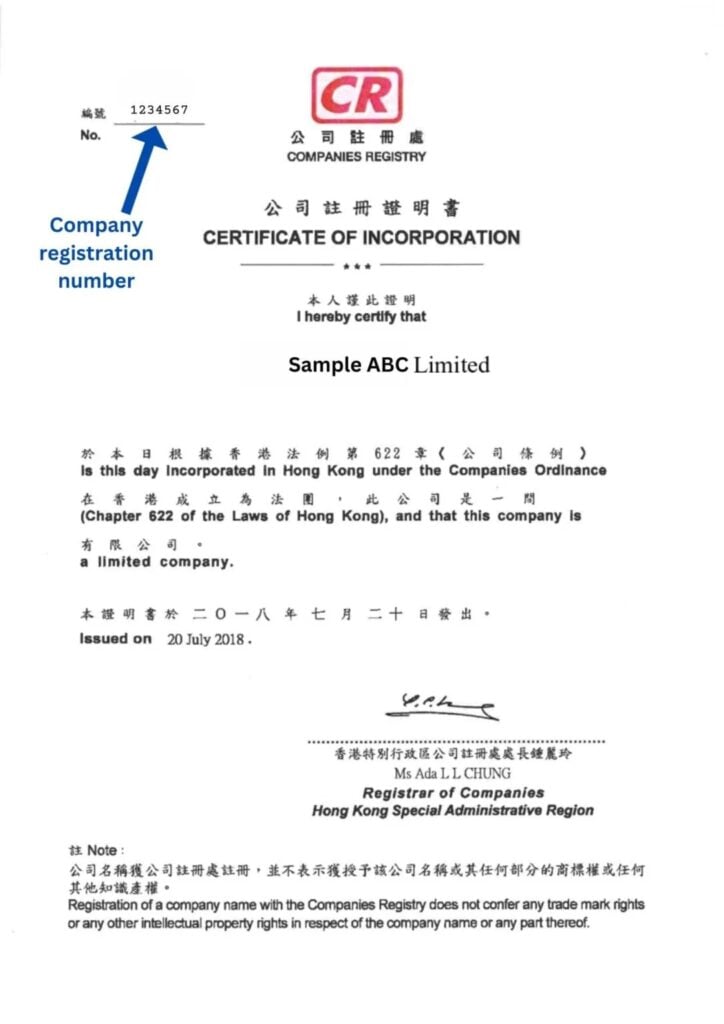
A Hong Kong Certificate of Incorporation is a standardised, one page legal document issued by the Companies Registry. While its format is concise, the information it contains is critical for legal compliance, banking, and commercial verification. Each element serves a specific regulatory and practical purpose.
Below is a breakdown of the key information you will find on a Hong Kong Certificate of Incorporation and why it matters.
Company Registration Number (Unique Identifier)
Every Certificate of Incorporation displays a unique Company Registration Number at the top of the document.
- Issued by the Companies Registry upon incorporation
- Used to identify the company in official records and public searches
- Required for statutory filings, company searches, and due diligence
This number allows regulators, banks, and third parties to verify a company’s legal existence through the Companies Registry’s public systems.
Reference to the Companies Ordinance
The certificate includes a formal reference to the Companies Ordinance (Cap. 622).
- Confirms that the company is incorporated under Hong Kong law
- Establishes the legal framework governing the company
- Demonstrates compliance with statutory incorporation requirements
This reference is particularly important for overseas investors and counterparties assessing whether a company has been properly formed under Hong Kong’s corporate regime.
Certificate Type
The title of the document clearly states the certificate type, which will read “Certificate of Incorporation”.
- Distinguishes it from other statutory certificates
- Confirms that the document relates to company formation
- Ensures clarity during compliance checks and audits
Banks and professional service providers often verify the certificate type to confirm they are reviewing the correct statutory document.
Official Company Name
The Certificate of Incorporation displays the company’s official registered name, exactly as approved by the Companies Registry.
Language format
- English name
- Traditional Chinese name
- Or both, if registered bilingually
Mandatory “Limited” suffix
- English names must end with “Limited”
- Chinese names must end with “有限公司”
The name shown on the certificate must match all other statutory records. Any discrepancy can result in delays when opening bank accounts or executing legal documents.
Date of Incorporation
The date of incorporation indicates when the company was officially registered and became a separate legal entity.
- Marks the start of the company’s legal existence
- Used to calculate compliance deadlines, such as annual returns
- Commonly requested during audits and due diligence
This date is often referenced in contracts and regulatory filings as the company’s official formation date.
Name and Signature of the Registrar of Companies
Each certificate is authenticated by the name and signature of the Registrar of Companies.
- Confirms the document is officially issued
- Validates the certificate’s legal authority
- Provides assurance of authenticity
This endorsement is essential for institutions that require formal proof of incorporation, particularly banks and regulators.
Why Accuracy of Certificate Details Matters
Accuracy on a Certificate of Incorporation is not optional. Errors or inconsistencies can create serious operational and compliance issues, including:
- Delays or rejection of corporate bank account applications
- Complications during investor due diligence
- Challenges with regulators, auditors, or counterparties
- Increased risk of compliance breaches
For this reason, companies should always ensure that the information on their Certificate of Incorporation matches their statutory filings and other official documents, and use certified copies when required by third parties.
Who Needs a Certificate of Incorporation in Hong Kong?
Not every business structure in Hong Kong is issued a Certificate of Incorporation. Under the Companies Ordinance, this certificate is a mandatory legal requirement for limited companies only, as it confirms their formal incorporation and legal existence.
Understanding which entities are entitled to, or excluded from, a Certificate of Incorporation helps avoid confusion during company setup, banking, and compliance processes.
1. Mandatory Requirement for Limited Companies Only
A Certificate of Incorporation is issued exclusively to companies incorporated under the Companies Ordinance. Without this certificate, a business cannot be recognised as a limited liability company in Hong Kong and cannot legally operate as such.
2. Entities That Receive a Certificate of Incorporation
The Companies Registry issues a Certificate of Incorporation to the following entity types:
2.1 Private companies limited by shares
- The most common company structure in Hong Kong
- Suitable for profit making businesses
- Shareholders’ liability is limited to their share capital
2.2 Companies limited by guarantee
- Commonly used by non profit organisations and charities
- Members’ liability is limited to a guaranteed amount
- No share capital structure
Both entity types become separate legal persons upon incorporation and are entered into the Companies Registry records.
3. Entities That Do Not Receive a Certificate of Incorporation
Certain business structures are not incorporated under the Companies Ordinance and therefore do not receive a Certificate of Incorporation.
3.1 Sole proprietorships
- Owned and operated by an individual
- No separate legal personality
- Registered only with the Inland Revenue Department
3.2 Partnerships
- Operated by two or more partners
- Not a separate legal entity from the partners
- Also registered only for business registration purposes
These entities receive a Business Registration Certificate, not a Certificate of Incorporation.
| Business Structure | Certificate of Incorporation | Business Registration Certificate |
| Private company limited by shares | ✅ | ✅ |
| Company limited by guarantee | ✅ | ✅ |
| Sole proprietorship | ❌ | ✅ |
| Partnership | ❌ | ✅ |
Practical Situations Where the Certificate Is Commonly Required
In practice, a Certificate of Incorporation is frequently requested as proof of legal status in situations such as:
- Opening or maintaining a corporate bank account
- Investor due diligence and funding discussions
- Signing commercial contracts or leases
- Appointing professional service providers
- Regulatory and statutory compliance checks
For limited companies, the Certificate of Incorporation is often the first document reviewed by banks, investors, and authorities. Ensuring that the correct entity type is incorporated from the outset is therefore critical for smooth operations and long term compliance in Hong Kong.
When Is the Certificate of Incorporation Issued and Is It Renewable?
Understanding the issuance timing and validity of the Hong Kong Certificate of Incorporation helps founders plan banking, licensing, and post incorporation compliance more effectively. This section clarifies when the certificate is issued, the available formats, and common misconceptions about renewal.
Issuance Timeline After Successful Incorporation
The Certificate of Incorporation is issued only after the Companies Registry approves the incorporation application and confirms that all statutory requirements under the Companies Ordinance have been met.
The issuance timeline depends largely on the submission method:
- Electronic application via e-Registry
- Certificate is usually issued within hours after approval
- Suitable for founders who need fast turnaround for banking or operational setup
- Paper application (by post or in person)
- Certificate is typically issued within four to five working days
- Collection notification is sent once the certificate is ready
Delays may occur if:
- The proposed company name is rejected
- Required documents are incomplete or inconsistent
- Statutory information requires clarification by the Companies Registry
Electronic vs Physical Certificate of Incorporation
Hong Kong recognises both electronic and physical Certificates of Incorporation as legally valid. There is no difference in legal effect between the two formats.
| Format | Key Features | Common Use Cases |
| Electronic certificate | Issued as a PDF, downloadable from the Companies Registry | Fast incorporation, online banking applications, digital record keeping |
| Physical certificate | Printed and collected from the Companies Registry | Internal records, jurisdictions or institutions requiring hard copies |
Permanent Validity of the Certificate
A Hong Kong Certificate of Incorporation has no expiry date.
Once issued, it remains valid for the entire lifespan of the company, provided the company continues to exist and is not deregistered or wound up. There is no annual or periodic renewal requirement under the Companies Ordinance.
If the original certificate is lost or damaged, the company may apply for a certified true copy from the Companies Registry, which carries the same evidentiary value as the original.
Common Misconceptions About Renewal Requirements
It is common for new founders to confuse the Certificate of Incorporation with other compliance documents. Key clarifications include:
- The Certificate of Incorporation does not need to be renewed
- It is not replaced annually
- It does not function as a business licence or tax certificate
However, companies must still:
- Renew their Business Registration Certificate annually or every three years
- File annual returns and maintain statutory records
- Comply with ongoing obligations under the Companies Ordinance
Understanding this distinction helps avoid unnecessary administrative errors and ensures proper compliance planning from the outset.
How to Obtain a Certificate of Incorporation in Hong Kong
Obtaining a Certificate of Incorporation in Hong Kong is a structured process governed by the Companies Ordinance. While the procedure is generally efficient, accuracy and compliance at each stage are critical to avoid delays. Below is a practical breakdown of the key steps involved, from name selection to issuance by the Companies Registry.
Step 1 – Company Name Selection
Choosing an appropriate company name is the first statutory step and a common source of incorporation delays if not handled carefully. Under Hong Kong law, a proposed company name must:
- Be distinct from existing registered company names
- Not be misleading or suggest a regulated activity without approval
- Not contain words prohibited or restricted under the Companies Ordinance or other legislation
Certain terms, such as those implying government affiliation or regulated professions, may require prior consent from relevant authorities.
Hong Kong allows companies to register:
- An English name only
- A Traditional Chinese name only
- Both an English and a Traditional Chinese name
If both are adopted, they are treated as two official names of the same company. Direct translation between languages is not required, but consistency in branding and documentation is strongly recommended.
Importance of Name Availability Search and Approval
Before submission, a name availability search should be conducted through the Companies Registry to confirm that:
- The name is not identical or confusingly similar to an existing company
- The name complies with statutory naming rules
Name approval is assessed during incorporation rather than reserved in advance, making preliminary checks essential for a smooth application.
Read The process of choosing a company name for registration in Hong Kong
Step 2 – Preparation of Incorporation Documents
Once the company name is confirmed, statutory incorporation documents must be prepared accurately and in full.
Incorporation Form (NNC1 / NNC1G)
The applicable incorporation form depends on the company type:
- Form NNC1: Private company limited by shares
- Form NNC1G: Company limited by guarantee
These forms include key details such as:
- Company name and registered office address
- Share capital and shareholder information (if applicable)
- Directors’ particulars
- Company secretary details
Any inconsistency or missing information may result in rejection or follow up queries from the Companies Registry.
Articles of Association
The Articles of Association set out the company’s internal governance rules, including:
- Shareholder rights and obligations
- Directors’ powers and procedures
- Meeting and voting arrangements
Hong Kong companies may adopt the Model Articles or customised articles, provided they comply with the Companies Ordinance.
Appointment of a Company Secretary
Appointment of a company secretary is a mandatory legal requirement for all Hong Kong limited companies. The company secretary must:
- Be a Hong Kong resident individual or a Hong Kong registered corporate service provider
- Maintain statutory records and compliance filings
A sole director cannot also act as the company secretary.
Business Registration Notice
The Business Registration Notice is submitted together with the incorporation application. This triggers the issuance of the Business Registration Certificate by the Inland Revenue Department after incorporation is approved.
Step 3 – Submission and Issuance
After preparation, the application is submitted to the Companies Registry for review and approval. Applicants may choose between:
- Online submission via the e-Registry
- Faster processing
- Electronic Certificate of Incorporation usually issued within one hour after approval
- Paper application
- Submitted by post or in person
- Processing typically takes four to five working days
Both methods are legally recognised, with no difference in the validity of the certificate issued.
Role of the Companies Registry
The Companies Registry is responsible for:
- Reviewing incorporation documents for statutory compliance
- Approving company names
- Issuing the Certificate of Incorporation upon successful registration
Only after formal approval does the company legally come into existence.
Typical Processing Timeframe
| Submission Method | Typical Issuance Time |
| Online (e-Registry) | Within one hour after approval |
| Paper application | Approximately 4–5 working days |
Processing time may be extended if:
- The proposed company name is rejected
- Incorporation documents are incomplete or inconsistent
- Additional clarification is required by the Companies Registry
- There is a high volume of applications during peak periods
Certificate of Incorporation vs Business Registration Certificate
New business owners in Hong Kong often confuse the Certificate of Incorporation with the Business Registration Certificate. While both documents are essential, they serve different legal and compliance purposes and are issued by separate authorities. Understanding the distinction is critical for proper company setup and ongoing compliance.
1. Differences in Purpose
Although these two certificates are commonly obtained around the same time, their functions are fundamentally different.
Legal Establishment vs Authorisation to Conduct Business
- Certificate of Incorporation
- Confirms that a company has been legally formed under the Companies Ordinance
- Establishes the company as a separate legal entity
- Applies only to limited liability companies, including companies limited by shares and by guarantee
- Business Registration Certificate
- Authorises a business to operate and generate profits in Hong Kong
- Applies to all business types, including limited companies, sole proprietorships and partnerships
In simple terms, incorporation creates the company, while business registration allows it to operate commercially.
2. Company Law Compliance vs Tax and Business Registration
The two certificates also sit under different regulatory frameworks:
- The Certificate of Incorporation focuses on company law compliance
- The Business Registration Certificate focuses on tax registration and business regulation
Both are mandatory for most Hong Kong companies, but they address different statutory requirements.
3. Issuing Authorities
Another key difference lies in the government bodies responsible for issuing each certificate.
- Companies Registry
- Issues the Certificate of Incorporation
- Regulates company formation and corporate compliance under the Companies Ordinance
- Inland Revenue Department
- Issues the Business Registration Certificate
- Oversees business registration and tax administration
Understanding which authority governs each certificate helps businesses respond correctly to compliance queries and official notices.
4. Identification Numbers and Usage
Each certificate carries its own identification number, and these numbers are used for different purposes.
Company Registration Number
- Issued with the Certificate of Incorporation
- A unique identifier assigned by the Companies Registry
- Commonly requested for:
- Corporate filings and statutory records
- Due diligence by banks, investors and counterparties
Business Registration Number (Tax ID)
- Issued with the Business Registration Certificate
- Functions as the company’s tax identification number
- Commonly used for:
- Profits tax filings
- Invoicing and commercial documentation
- Dealings with the Inland Revenue Department
Using the correct number in the appropriate context is important to avoid administrative or compliance issues.
5. Why Most Hong Kong Companies Require Both
For limited companies in Hong Kong, holding both certificates is not optional but a practical necessity. A typical Hong Kong limited company must:
- Obtain a Certificate of Incorporation to exist legally as a company
- Obtain a Business Registration Certificate to carry on business and comply with tax obligations
Without either document, the company cannot fully operate or meet statutory requirements. New founders often assume one certificate replaces the other or the Business Registration Certificate alone is sufficient. In practice, banks, regulators and professional service providers may request both certificates during onboarding, compliance checks or audits.
Comparison Certificate of Incorporation vs Business Registration Certificate
| Feature | Certificate of Incorporation | Business Registration Certificate |
| Primary purpose | Legal establishment of a company | Authorisation to conduct business |
| Governing law | Companies Ordinance | Business Registration Ordinance |
| Issued by | Companies Registry | Inland Revenue Department |
| Required for | Limited liability companies only | All profit generating businesses |
| Identification number | Company Registration Number | Business Registration Number (Tax ID) |
| Used for | Corporate compliance and legal status | Tax filings and business operations |
How to Verify the Authenticity of a Hong Kong Certificate of Incorporation
Verifying the authenticity of a Hong Kong Certificate of Incorporation is an important step in due diligence, compliance checks, and commercial transactions. Banks, investors, professional service providers, and counterparties often require confirmation that a company is properly incorporated and legally registered with the Companies Registry. Hong Kong provides several official and reliable methods to verify this information.
1. Online Verification via ICRIS
The most efficient way to verify a Certificate of Incorporation is through the Integrated Companies Registry Information System (ICRIS), which is operated by the Hong Kong Companies Registry.
ICRIS is a bilingual online platform that allows the public to conduct searches on registered Hong Kong companies at any time.
Information available through public search includes:
- Company name in English and or Traditional Chinese
- Company Registration Number
- Date of incorporation
- Company status, such as live or dissolved
- Record of company name changes, if applicable
This online verification method is commonly used for:
- Preliminary due diligence
- Vendor and counterparty checks
- Confirming incorporation details before signing contracts
While basic information can be viewed through public search, downloading official records or documents may be subject to government fees.
2. Obtaining Certified True Copies
In situations where higher assurance is required, online verification alone may not be sufficient. In such cases, Certified True Copies of the Certificate of Incorporation are commonly requested.
A Certified True Copy is an official copy of the original certificate, certified by the Registrar of Companies as a true and accurate reproduction.
When certified copies are typically required:
- Corporate bank account opening
- Regulatory reviews and audits
- Investor due diligence
- Overseas authority submissions
Application channels include:
- Online application via the Companies Registry Cyber Search Centre
- In-person application at designated Companies Registry service counters
Certified True Copies carry official certification and are widely accepted by banks, government authorities, and professional institutions both in Hong Kong and overseas.
3. Company Search Reports
For more comprehensive verification, a Company Search Report can be obtained from the Companies Registry. This report provides an expanded overview of a company’s statutory and registration information.
Company search reports typically include:
- Incorporation details and company status
- Registered office address
- Directors and company secretary information
- Share capital structure
- Historical filings and name change records
Common due diligence and compliance scenarios include:
- Mergers and acquisitions
- Investment and financing transactions
- Legal and compliance reviews
- Long-term commercial partnerships
Compared with basic online searches, company search reports offer deeper insight into a company’s compliance history and corporate structure, making them a preferred option for professional due diligence.
Summary of Verification Methods
| Verification method | Level of detail | Typical use cases |
| ICRIS online search | Basic company details | Initial checks, quick verification |
| Certified True Copy | Official certified document | Banking, regulatory and legal purposes |
| Company search report | Comprehensive company records | Due diligence, audits, transactions |
Ongoing Compliance Obligations After Issuance
Once a Hong Kong Certificate of Incorporation has been issued, a company must continue to meet specific statutory and administrative obligations. While the certificate itself does not require renewal, companies must ensure proper display, maintain related registrations, and know how to handle document replacement if needed.
Display Requirements at the Registered Business Premises
Under Hong Kong law, certain statutory documents must be displayed at the company’s registered office or principal place of business.
Key display requirements include:
- The Certificate of Incorporation
- The Business Registration Certificate
Both documents should be displayed in a conspicuous location that is easily accessible to the public. This requirement applies regardless of whether the certificates are issued in electronic or hard copy form. Failure to comply may result in penalties or regulatory issues during inspections.
No Renewal Required for the Certificate of Incorporation
The Certificate of Incorporation is a one-time issuance document.
- It has no expiry date
- It does not require annual or periodic renewal
- It remains valid for the lifetime of the company, unless the company is deregistered or wound up
Once issued, the certificate continues to serve as permanent legal proof of the company’s incorporation under the Companies Ordinance.
Renewal Obligations for the Business Registration Certificate
While the Certificate of Incorporation does not require renewal, the Business Registration Certificate must be renewed regularly.
Business Registration renewal options include:
- One-year validity, or
- Three-year validity, depending on the option selected at registration or renewal
The Business Registration Certificate is issued by the Inland Revenue Department and is linked to the company’s tax and business operation status. Late renewal may result in fines, penalties, or operational disruptions.
Replacement Options if the Certificate Is Lost
If the original Certificate of Incorporation is lost, damaged, or misplaced, companies can apply for an official replacement.
Available replacement option:
- Application for a Certified True Copy from the Companies Registry
Certified True Copies are legally recognised and widely accepted by banks, government authorities, and professional service providers as valid proof of incorporation.
Application channels typically include:
- Online application via the Companies Registry Cyber Search Centre
- In-person application at designated Companies Registry service points
Compliance Overview Table
| Compliance area | Certificate of Incorporation | Business Registration Certificate |
| Display at premises | Required | Required |
| Renewal required | No | Yes, annually or every three years |
| Issuing authority | Companies Registry | Inland Revenue Department |
| Replacement option | Certified True Copy | Replacement certificate available |
| Legal validity | Permanent unless company ceases | Valid only within renewal period |
Common Mistakes and Compliance Risks to Avoid
Even after obtaining a Hong Kong Certificate of Incorporation, many companies face compliance issues due to misunderstandings or document misuse. Below are the most common mistakes to avoid, particularly for new founders and overseas investors, along with practical guidance to stay compliant under Hong Kong law.
1. Incorporation vs Business Registration Confusion
A frequent compliance risk is assuming that incorporation alone is sufficient to legally operate a business in Hong Kong. In reality, the Certificate of Incorporation and the Business Registration Certificate serve different statutory purposes and are issued by separate authorities.
Key distinctions to remember:
- The Certificate of Incorporation confirms the company’s legal existence under the Companies Ordinance.
- The Business Registration Certificate authorises the company to carry on business and serves as its tax identification number.
- Limited companies must obtain and maintain both documents.
Failing to register for business registration, even after incorporation, may result in penalties and enforcement action by the Inland Revenue Department.
2. Using the Wrong Certificate for Banking or Tax
Banks, auditors, and government departments often require specific documents for verification. Providing the incorrect certificate can delay approvals or lead to rejected applications.
Some scenarios include:
- Submitting the Business Registration Certificate when a bank specifically requests the Certificate of Incorporation.
- Using the Certificate of Incorporation in place of the Business Registration Certificate for tax or IRD-related matters.
- Providing uncertified copies when certified true copies are required.
To avoid issues, always confirm which document is required and whether certification is needed before submission.
3. Inconsistent or Incorrect Company Name Usage
The company name stated on the Certificate of Incorporation is the only legally recognised name of the company. Using variations or abbreviations can create compliance and contractual risks.
Some of the common mistakes are :
- Omitting “Limited” or “Ltd” in contracts or invoices
- Using an English name when only a Chinese name is registered, or vice versa
- Using a trading name that does not match the registered name without proper disclosure
All official documents, banking forms, and statutory filings should match the company name exactly as shown on the Certificate of Incorporation.
4. Failure to Maintain Statutory Records
Incorporation is only the first step. Hong Kong companies must maintain proper statutory records on an ongoing basis as required under the Companies Ordinance.
These include:
- Register of directors, shareholders, and company secretary
- Significant Controllers Register
- Minutes of directors’ and shareholders’ meetings
- Updated incorporation and constitutional documents
Failure to keep these records up to date may lead to penalties and compliance issues during audits, due diligence, or regulatory reviews.
5. Using Outdated or Uncertified Documents
Another common risk is relying on outdated documents or uncertified copies for official purposes. Many third parties require the most recent version of company records.
Examples include:
- Using an old Certificate of Incorporation after a company name change
- Providing non-certified copies where certified true copies are required
- Submitting documents that do not reflect recent changes in directors or shareholders
If original documents are lost or updated records are required, companies can apply for certified copies from the Companies Registry, which are widely accepted by banks and authorities.
Practical Tips for Overseas and First-Time Founders
Setting up a company in Hong Kong is relatively straightforward, but overseas and first-time founders often face practical challenges after incorporation. Understanding documentation requirements and ongoing obligations is essential to avoid compliance risks and operational delays.
1. Navigating Bilingual Corporate Documentation
Hong Kong operates under a bilingual legal system. Most statutory documents, including the Certificate of Incorporation, are issued in English and Traditional Chinese.
Key points to note:
- Your company may be registered with an English name, a Chinese name, or both.
- The registered name shown on the Certificate of Incorporation must be used consistently across all official documents.
- Banks, regulators, and counterparties may request documents in one or both languages.
For overseas founders, discrepancies between English and Chinese company names can cause unnecessary delays in bank account applications, contract execution, and compliance reviews. Always ensure that the bilingual versions match the Companies Registry records.
2. Why Ongoing Statutory Compliance Matters
Obtaining a Certificate of Incorporation is only the starting point. Hong Kong companies are subject to continuous statutory obligations under the Companies Ordinance.
Failure to meet these obligations can result in:
- Financial penalties and late filing fees
- Compliance flags during bank or investor due diligence
- Risk of prosecution for directors and officers
Common ongoing requirements include:
- Maintaining a registered office address in Hong Kong
- Appointing and retaining a qualified company secretary
- Filing annual returns with the Companies Registry
- Renewing the Business Registration Certificate on time
For first-time founders, understanding that compliance is ongoing, not a one-off task, is critical.
3. Record-Keeping and Filing Obligations
Hong Kong companies must maintain accurate and up-to-date statutory records at all times. These records may be requested by regulators, auditors, banks, or business partners.
Typical records include:
- Certificate of Incorporation and Business Registration Certificate
- Articles of Association
- Registers of directors, shareholders, and company secretary
- Significant Controllers Register
- Annual returns and statutory filings
The table below summarises key record-keeping requirements:
| Record Type | Retention Requirement | Common Use Cases |
| Certificate of Incorporation | Permanent | Banking, contracts, due diligence |
| Statutory Registers | Ongoing updates | Compliance reviews, audits |
| Annual Returns | Filed annually | Legal and regulatory compliance |
| Business Registration Certificate | Renew annually or every three years | Tax and operational verification |
Using outdated or inconsistent records is a common compliance risk, particularly for overseas-managed companies.
4. When to Engage Professional Service Providers
For overseas and first-time founders, working with professional service providers can significantly reduce administrative burden and compliance risk.
A professional company secretary can:
- Handle statutory filings and deadlines
- Maintain statutory registers accurately
- Act as a liaison with the Companies Registry and other authorities
- Support bank account opening documentation and compliance reviews
Engaging professionals early helps ensure that your company remains compliant from incorporation onward, allowing founders to focus on business growth rather than regulatory administration. For many overseas founders, professional support is not just a convenience but a practical safeguard against avoidable compliance issues in Hong Kong.
How a Professional Company Secretary Can Help
Under the Companies Ordinance, every Hong Kong limited company must appoint a company secretary. Beyond meeting a statutory requirement, a professional company secretary plays a critical role in supporting incorporation, compliance, and ongoing operations, particularly for overseas founders.
1. Managing Incorporation and Statutory Documentation
A professional company secretary ensures that all incorporation documents are prepared accurately and submitted in accordance with Companies Registry requirements.
This includes:
- Coordinating the issuance of the Certificate of Incorporation
- Preparing and maintaining Articles of Association
- Ensuring correct use of the registered English and Chinese company names
- Safeguarding statutory documents for future reference
Proper documentation from day one helps prevent delays in bank account applications, contract execution, and regulatory reviews.
2. Ensuring Compliance from Day One
Compliance obligations in Hong Kong begin immediately after incorporation. A professional company secretary helps companies stay compliant throughout their lifecycle, not just at setup.
Key responsibilities include:
- Filing annual returns with the Companies Registry
- Monitoring statutory deadlines and renewal dates
- Maintaining the registered office address and statutory registers
- Supporting compliance under the Companies Ordinance
This proactive oversight reduces the risk of late filings, penalties, and compliance breaches.
3. Acting as Liaison With Hong Kong Authorities
Navigating Hong Kong’s regulatory environment can be challenging for non-resident directors. A company secretary acts as a reliable point of contact between the company and local authorities.
This role typically involves:
- Communicating with the Companies Registry on statutory matters
- Assisting with certified true copy applications
- Supporting verification requests through official channels such as ICRIS
- Handling correspondence from government departments
Having a local professional interface improves response times and ensures accurate communication.
4. Reducing Administrative Delays and Compliance Risks
Administrative inefficiencies often arise when overseas founders manage compliance without local expertise. A professional company secretary helps streamline processes and reduce avoidable risks.
Conclusion
The Certificate of Incorporation is the legal foundation of a Hong Kong limited company, confirming its existence under the Companies Ordinance and enabling it to operate with credibility. Understanding how this certificate fits within Hong Kong’s broader documentation framework, including the Business Registration Certificate and ongoing statutory records, is essential for smooth operations. Compliance is not a one-time task but a continuous obligation that affects banking, investor confidence, and regulatory standing. For overseas and first-time founders, engaging professional incorporation and company secretarial support helps ensure compliance, strengthens credibility, and allows the business to operate with confidence and readiness from day one.
How FastLane Group Can Help
FastLane Group supports founders, SMEs, and overseas investors throughout the entire company lifecycle in Hong Kong, with a strong focus on compliance and practicality. Our team ensures that your Certificate of Incorporation and related statutory documents are properly issued, maintained, and meet regulations. Contact us today to discuss your incorporation and company secretarial needs.
Frequently Asked Questions (FAQ)
1. What is a Hong Kong Certificate of Incorporation?
A Hong Kong Certificate of Incorporation is an official legal document issued by the Companies Registry. It confirms that a company has been duly incorporated under the Companies Ordinance (Cap. 622) and legally exists as a separate entity in Hong Kong.
2. Is it mandatory for all businesses?
No. A Certificate of Incorporation is mandatory only for limited companies, including:
- Companies limited by shares
- Companies limited by guarantee
Sole proprietorships and partnerships do not receive a Certificate of Incorporation.
3. Is it the same as a business licence?
No. The Certificate of Incorporation is not a business licence. It confirms legal establishment under company law. A separate Business Registration Certificate, issued by the Inland Revenue Department, is required to conduct business activities and for tax registration.
4. Who issues the Certificate of Incorporation?
The Certificate of Incorporation is issued by the Hong Kong Companies Registry upon successful completion of the incorporation process.
5. Does the Certificate of Incorporation expire?
No. A Certificate of Incorporation does not have an expiry date and does not need to be renewed. However, the Business Registration Certificate must be renewed annually or every three years, depending on the option selected.
6. Can a replacement be obtained if it is lost?
Yes. If the original Certificate of Incorporation is lost, damaged, or misplaced, a certified true copy can be obtained from the Companies Registry through its online system or in person, subject to the applicable fee.
7. Is it required for dormant companies?
Yes. Even if a company is dormant, it must still hold a valid Certificate of Incorporation, as the document confirms the company’s legal existence. Dormant companies may have reduced compliance obligations, but incorporation status remains unchanged.