





Choosing the right business structure is one of the most important decisions for any entrepreneur entering Hong Kong’s highly competitive and internationally connected marketplace. Among all the available options, the private limited company remains the most popular choice for both local and foreign business owners — thanks to its limited liability protection, tax efficiency, and strong credibility with banks, investors, and partners.
This guide provides a complete, up-to-date overview of private limited companies in Hong Kong. Whether you’re a startup founder, SME owner, or overseas entrepreneur exploring market entry, you’ll find everything you need to understand how this company type works, its advantages and disadvantages, how to register one, compliance requirements, ongoing costs, and how it compares to other business structures.
Our goal is to give you clear, practical, and structured guidance so you can make an informed decision about whether a private limited company is right for your business in 2026 and beyond.
What Is a Private Limited Company in Hong Kong?
A Private Limited Company (officially “Private Company Limited by Shares”) is a business entity incorporated under Hong Kong’s Companies Ordinance (Cap. 622). It is the most common business structure for entrepreneurs because it offers limited liability, a separate legal identity, and full foreign ownership, all while operating in one of the world’s most business-friendly jurisdictions.
Unlike a sole proprietorship or partnership, a private limited company is recognized as an independent legal entity. It can own assets, sign contracts, incur debts, sue or be sued in its own name — providing a clear legal separation between the company and its owners. This separation is a major reason why both local and overseas founders prefer this structure for asset protection and long-term growth.
To qualify as a private company under Hong Kong law, it must meet three requirements:
- It cannot offer its shares to the public
- Its number of shareholders is capped at 50
- Share transfers may be restricted (depending on the Articles of Association)
These features make private limited companies ideal for SMEs, startups, and foreign investors who want a stable, credible, and tax-efficient vehicle for operating in or from Hong Kong.
Key Characteristics of a Hong Kong Private Limited Company
To help you understand the structure more clearly — and offer more depth than competitor articles — here are the defining features that every founder should know:
Separate Legal Entity
The company exists independently from its shareholders and directors. This reduces personal exposure to business risks and increases credibility with clients, banks, and investors.
Limited Liability Protection
Shareholders are only liable up to the amount of their subscribed share capital. Personal assets remain protected unless fraud or misconduct occurs.
100% Foreign Ownership Allowed
Hong Kong imposes no local shareholder requirement, making the structure particularly attractive for international entrepreneurs entering Asia.
Simple Share Capital Requirements
There is no minimum capital requirement. Most companies incorporate with HK$1–10,000 in share capital, which is sufficient for compliance and banking.
Flexible Corporate Structure
A Hong Kong private limited company requires at minimum:
- 1 individual director (no corporate directors allowed for private companies)
- 1 shareholder (can be the same person)
- 1 Company Secretary (must be a Hong Kong resident or licensed corporate body)
- A registered office address in Hong Kong
Strong Legal and Regulatory Framework
The Companies Registry operates with fast digital filing, clear compliance rules, and one of the world’s most efficient incorporation systems.
Attractive Tax Environment
Private limited companies benefit from Hong Kong’s territorial tax regime and two-tier profits tax system. Companies only pay tax on profits sourced in Hong Kong — a key advantage for many international businesses.
Why This Structure Is the Default Choice for Most Entrepreneurs
Competitor sites often mention the basics, but users are really asking: “Why should I choose this over other structures?”
Here’s the real-world reasoning:
- It is the only structure suitable for companies seeking investors or venture capital
- It provides credibility for opening local and overseas bank accounts
- It supports regional or international expansion better than a sole proprietorship
- It allows flexible ownership changes, making it easier to sell or restructure the business
Entrepreneurs who want long-term stability, brand reputation, and protection from liability almost always choose a private limited company.
Who Should Use a Private Limited Company in Hong Kong?
A Hong Kong private limited company is more than a registration form; it is a decision about how your business will be structured, protected, and perceived. While almost any business can adopt this model, it delivers the most value to founders planning for scale, external stakeholders, and cross-border activity.
The real question is not “Can I use a private limited company?” but “Does my business model justify the structure, governance, and compliance that come with it?”
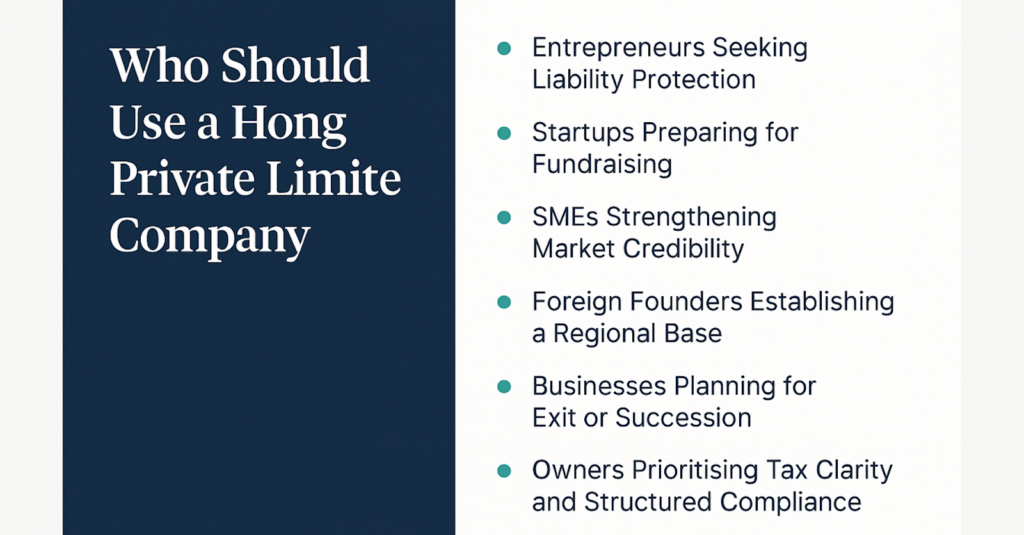
Entrepreneurs Who Need Meaningful Liability Protection
If your business carries contractual, operational, or financial risk, operating as a sole proprietor quickly becomes inadequate. A private limited company creates a clear legal boundary between the company and its owners, so shareholders are generally liable only up to the amount of their contributed capital.
This matters for consultants handling high-value mandates, trading and e-commerce businesses exposed to logistics or product risk, and technology or service providers that work on long-term contracts or performance-based deliverables. In these cases, limited liability is not a technical feature; it is a core risk-management tool.
Startups and High-Growth Businesses Planning to Raise Capital
Investors do not fund informal structures; they fund scalable vehicles. For venture capital, angel investment, or strategic partners, a private limited company is the expected baseline because it offers a defined share structure, the ability to issue new shares or classes, and a governance framework that supports board oversight and shareholder rights.
If you expect to raise external capital, introduce co-founders on equity, or implement employee share schemes, a private limited company shifts from “nice to have” to “non-negotiable.”
SMEs That Compete on Credibility and Professionalism
In B2B and higher-value B2C segments, perception directly influences revenue. Clients, suppliers, and institutional partners are generally more comfortable dealing with a properly incorporated company than with an individual or informal partnership.
For professional services firms, agencies, tech companies, and trading businesses, the “Limited” suffix often signals stronger governance, clearer accountability, and a long-term commitment to the market. That same perception extends to banks, payment providers, and other financial institutions, improving the likelihood of successful onboarding.
Foreign Founders Using Hong Kong as a Regional or Global Base
Hong Kong remains a preferred jurisdiction for foreign entrepreneurs because the private limited structure is accessible and internationally recognized. It allows 100% foreign ownership, does not require a local shareholder or director, and can typically be incorporated without the founder being physically present.
For businesses using Hong Kong as:
- a regional headquarters
- a trading hub
- a holding company
- a service platform for Asia
The private limited company provides international credibility while keeping the structure relatively straightforward.
Businesses Thinking Beyond the Founder
Some ventures are started with an exit, succession plan, or eventual sale in mind. A private limited company is better suited to those ambitions than informal structures because it has perpetual succession and transferable shares. Ownership can change without disrupting contracts, operations, or branding.
This is particularly relevant if you:
- intend to bring in new partners over time
- might sell all or part of the business
- want to pass the company to the next generation or a management team
The structure creates continuity beyond any individual founder.
Owners Who Value Tax Clarity and Structured Compliance
While tax should never be the only reason to choose a structure, it is a practical consideration. Hong Kong’s two-tier profits tax regime and territorial basis of taxation sit more naturally within a corporate framework than a purely personal one.
A private limited company makes it easier to:
- separate personal and business finances
- maintain proper accounting records
- document deductible business expenses
- present clean, audited financial statements to banks and investors
For business owners who prefer predictability and transparency in their tax and financial affairs, this structure offers a more robust platform.
When a Private Limited Company Is the Right Call
In practical terms, a Hong Kong private limited company is usually the right choice when you:
- expect to grow beyond a one-person operation
- want meaningful liability protection
- aim to attract investors, partners, or institutional clients
- rely on banking and payment relationships for your business model
- operate cross-border or plan regional expansion
If you are building something designed to last — rather than testing a small idea with minimal risk — the private limited company is very often the most sensible foundation.
The Structure of a Private Limited Company in Hong Kong
A private limited company in Hong Kong is built on a simple yet robust corporate framework designed to balance operational flexibility with governance and accountability. Understanding how the structure works is essential, not only for compliance, but also for appreciating why this entity type is favored by investors, banks, and internationally minded entrepreneurs.
Hong Kong’s Companies Ordinance (Cap. 622) sets out clear requirements for the internal composition of a private limited company. Although these requirements are relatively lightweight compared with other jurisdictions, they create a level of stability and transparency that sole proprietorships and partnerships lack.
Board and Management Structure
At the top of the company is the board of directors, responsible for managing the company’s business, approving strategic decisions, and ensuring compliance with statutory obligations. Hong Kong requires at least one individual director, who may be of any nationality and need not reside in Hong Kong.
Unlike some offshore jurisdictions, Hong Kong does not allow corporate directors for private companies. This rule enhances accountability and ensures that the entity always has a clearly identifiable individual overseeing its operations.
While many small businesses operate with a single director–shareholder, companies planning for growth often appoint multiple directors to create clearer oversight and division of responsibilities.
Shareholders and Ownership
Ownership of a private limited company is expressed through shares, which represent equity in the business. A Hong Kong company must have at least one shareholder, and can have up to 50, as required for private-company status.
Shares may be:
- wholly foreign-owned
- held by individuals or corporate entities
- issued, transferred, or restructured based on the company’s needs
This flexibility is one reason why private limited companies are the standard structure for startups and growth businesses. The ability to introduce new investors, create employee equity plans, or reorganize ownership through share transfers provides strategic versatility that simpler structures cannot match.
Company Secretary
Every Hong Kong private limited company must appoint a Company Secretary, a role that carries legal significance. The secretary ensures the company meets its statutory duties under the Companies Ordinance, including maintaining corporate records, overseeing filings, and ensuring corporate governance standards are met.
The secretary must be either:
- an individual who resides in Hong Kong, or
- a Hong Kong-based corporate service provider
This requirement strengthens compliance and provides stability, particularly for foreign-owned companies that may not be familiar with local regulatory practices.
Read Role & Responsibilities of Company Secretary in Hong Kong
Registered Office Address
All companies must maintain a registered office address in Hong Kong, which serves as the official location for receiving government correspondence, legal notices, and statutory records.
This address must be a physical location — not a P.O. box — and must be accessible for the storage and inspection of corporate documents such as the Significant Controllers Register (SCR) and various statutory records.
For companies operating remotely or internationally, professional firms typically provide this service as part of corporate governance support.
Share Capital and Financial Structure
Hong Kong imposes no minimum share capital, allowing companies to incorporate with as little as HK$1. Even so, many businesses choose to issue a modest number of shares (e.g., HK$1,000–HK$10,000) to create flexibility for future ownership changes.
Key advantages of Hong Kong’s share system include:
- the ability to issue additional shares
- straightforward share transfers
- flexibility to adjust ownership ratios as the company evolves
The simplicity of Hong Kong’s capital framework makes it well-suited for both early-stage startups and established regional operations.
Statutory Records and Governance Documents
A Hong Kong private limited company must maintain:
- Articles of Association (its governing document)
- Register of Directors
- Register of Shareholders
- Significant Controllers Register (SCR)
- Records of resolutions and meeting minutes
These documents form the legal backbone of the company and ensure transparency in ownership and governance. While these obligations may seem administrative, they are significantly lighter than those imposed on companies in many Western jurisdictions — one of the reasons Hong Kong remains an attractive place for incorporation.
How This Structure Supports Growth
The design of the Hong Kong private limited company is more than a compliance checklist. It creates:
- a governance model that scales with the business
- a clear allocation of authority and responsibility
- a recognized and trusted format for international transactions
- a compliance framework that supports banking, investment, and cross-border expansion
This combination of simplicity and credibility is why the private limited company remains the preferred vehicle for serious entrepreneurs and investors.
Advantages of a Private Limited Company in Hong Kong
The private limited company has become the dominant business structure in Hong Kong for a reason: it combines legal protection, operational flexibility, and an internationally recognizable corporate identity in a way that few other structures can match. While Hong Kong is known for its ease of doing business, the benefits of a private limited company extend far beyond administrative convenience. For many founders, it is the vehicle that enables growth, investment, and long-term stability.
Below are the key advantages — explained not merely as features, but as strategic strengths that shape how a company operates and scales in Hong Kong and beyond.
Limited Liability and Personal Asset Protection
Perhaps the most significant advantage is the separation between the company and its owners. A private limited company is treated as its own legal entity, which means shareholders are generally liable only up to the amount they have invested.
In practice, this protects founders from personal exposure to business debts, litigation, or contractual issues. For entrepreneurs entering new markets, launching new products, or signing sizable agreements, this legal boundary is invaluable. It transforms business risk from a personal threat into a manageable corporate responsibility.
A Distinct Legal Identity That Builds Credibility
The corporate form itself carries weight. A Hong Kong private limited company can enter contracts, own assets, and conduct business in its own name, which signals permanence and professionalism to clients, vendors, and institutions.
For businesses that sell to enterprise customers, operate in regulated industries, or rely on a network of global partners, this formal identity often becomes a competitive advantage. It is easier to negotiate terms, onboard suppliers, and establish trust when the counterparty recognizes a stable corporate structure.
Access to Hong Kong’s Attractive Tax Regime
Hong Kong’s tax environment is one of the most business-friendly in the world, and a private limited company is the structure best suited to benefit from it. Companies enjoy the two-tier profits tax system, with a lower rate applied to the first HK$2 million in profits and a flat rate for the remainder.
Equally important is Hong Kong’s territorial basis of taxation: profits are generally taxed only if they arise in Hong Kong. For businesses operating regionally, digitally, or internationally, this clarity can create significant tax efficiency.
The corporate structure also enables cleaner accounting, better documentation, and clearer boundaries between personal and business finances — all of which strengthen the company’s financial credibility.
Flexibility for Ownership, Investment, and Scaling
One of the defining benefits of a private limited company is its ability to accommodate growth. Shares can be issued, transferred, or restructured as needed, making it easy to bring in co-founders, investors, or key employees through equity arrangements.
This is why virtually all venture-backed startups, growth companies, and acquisition-ready businesses incorporate as private limited companies. The structure provides the flexibility investors expect and the governance transparency institutions rely on.
Perpetual Succession and Continuity
Unlike sole proprietorships or partnerships, which are tied to the individuals who run them, a private limited company continues to exist regardless of changes in ownership or management. This continuity is critical for long-term contracts, financing arrangements, and succession planning.
It also reduces operational risk: a founder’s departure, sale of shares, or change in leadership does not disrupt the company’s legal standing or ability to conduct business.
Professional Standing with Banks and Financial Institutions
Banking has become increasingly stringent worldwide, and Hong Kong is no exception. A private limited company, with its documented governance structure, financial records, and statutory obligations, tends to present a stronger case during account opening and ongoing compliance reviews.
Financial institutions typically view private limited companies as more transparent, more trackable, and more committed to long-term operations — factors that improve the likelihood of successful onboarding.
Efficient Cross-Border Operations and International Recognition
Hong Kong’s legal and corporate framework is widely recognized by institutions around the world. A Hong Kong private limited company is often accepted as a suitable vehicle for:
- regional headquarters
- international trading
- holding structures
- cross-border service delivery
Its familiarity in global commercial environments reduces friction and enhances the company’s ability to operate across markets with fewer structural obstacles.
A Foundation Built for Growth, Stability, and Trust
Individually, advantages like limited liability, tax clarity, and credibility matter. But collectively, they form a long-term business platform: a structure that protects founders, appeals to investors, satisfies banks, and adapts to growth. This combination explains why the private limited company is the default choice for serious entrepreneurs and why it remains central to Hong Kong’s reputation as a global business hub.
Disadvantages of a Private Limited Company in Hong Kong
While the private limited company is often the most advantageous structure for long-term growth, it is not without its drawbacks. These disadvantages do not negate the strengths of the entity, but they do require founders to understand the obligations and operational expectations that come with running a formal corporate body. For some entrepreneurs — especially early-stage founders or those running micro-businesses — these requirements may outweigh the benefits.
In evaluating these disadvantages, it’s helpful to approach them not as deterrents, but as considerations that help determine whether the private limited model aligns with your business’s scale, risk profile, and available resources.
More Compliance and Administrative Obligations
A private limited company carries statutory responsibilities that simpler structures do not. These obligations include maintaining accounting records, preparing annual financial statements, undergoing an annual audit (with limited exceptions), filing annual returns, and keeping statutory registers such as the Significant Controllers Register (SCR).
For small or early-stage businesses, this means:
- more time spent meeting deadlines
- the need for professional support (company secretary, accountants)
- consistent record-keeping and documentation
While none of these requirements are exceptionally burdensome, they do represent a step up from the low-maintenance nature of sole proprietorships or partnerships.
Higher Setup and Ongoing Costs
Incorporating a private limited company comes with costs that other business structures avoid. Beyond initial incorporation fees, companies must maintain:
- a registered office
- a company secretary
- bookkeeping and accounting services
- annual audit services
These obligations are not prohibitive — in fact, they are modest by global standards — but they do translate into a fixed operational cost every year. For founders launching a very small or experimental venture, these expenses may feel disproportionate to the business’s early-stage revenue.
Stricter Governance Expectations
A private limited company brings with it a set of governance standards designed to protect shareholders, creditors, and the integrity of Hong Kong’s corporate environment. Directors must perform their duties with care and act in the best interests of the company, while shareholders’ rights and obligations must be respected according to the Articles of Association.
This added structure is beneficial for most growing companies, but founders who prefer informal operations or rapid decision-making without documentation may find the formality restrictive. The model rewards discipline — and penalizes businesses that overlook compliance.
Mandatory Transparency and Record-Keeping
Hong Kong’s corporate regime emphasizes accountability. Companies must maintain a clear record of ownership, significant controllers, capital structure, and corporate decisions. Some of these records must be accessible at the registered office.
For founders used to operating informally, the transition to a model built on documented decision-making and traceability can feel like an administrative burden. However, this transparency is precisely what lends Hong Kong corporations their global credibility.
Banking and Regulatory Scrutiny Have Increased
While Hong Kong remains a leading financial center, global banking regulations have tightened significantly in recent years. Opening a corporate bank account for a newly formed company — especially one with foreign ownership — can involve rigorous checks, business justification, and ongoing compliance reviews.
This does not mean banking is inaccessible; rather, it means companies must be prepared with:
- clear business models
- proper documentation
- evidence of genuine commercial activities
For founders expecting frictionless bank account opening, this can come as a surprise.
Winding Up or Deregistering Takes Time
Closing a private limited company is not as simple as stopping operations. Deregistration requires meeting several conditions, settling outstanding liabilities, and obtaining clearance from the Inland Revenue Department. If done incorrectly, the process can become lengthy.
For businesses intended to be temporary, low-risk, or experimental, this added complexity makes the private limited structure less appealing.
A Structure That Rewards Commitment — Not Experimentation
The disadvantages of a private limited company are not flaws in the system; they are characteristics of a structure designed for stability, trust, and long-term operation. For founders who want to build with intention, these requirements are simply part of the ecosystem. But for hobby projects, short-term ventures, or businesses not ready to formalize their governance, the compliance and cost commitments may feel misaligned with their needs.
Advantages vs Disadvantages of a Private Limited Company in Hong Kong
| Advantages | Disadvantages |
| Limited liability and personal asset protection | More compliance and administrative obligations |
| A distinct legal identity that builds credibility | Higher setup and ongoing costs |
| Access to Hong Kong’s attractive tax regime | Stricter governance expectations |
| Flexibility for ownership, investment, and scaling | Mandatory transparency and record-keeping |
| Perpetual succession and continuity | Banking and regulatory scrutiny have increased |
| Professional standing with banks and financial institutions | Winding up or deregistering takes time |
| Efficient cross-border operations and international recognition | — |
| A foundation built for growth, stability, and trust | — |
Private Limited Company vs Other Business Structures in Hong Kong
Choosing the right business structure in Hong Kong isn’t merely a legal formality — it defines how your company will operate, how it is taxed, how it is perceived, and how it can grow. While the private limited company is the most widely used structure, it is not the only option. Sole proprietorships, partnerships, and public companies each offer their own advantages and limitations, and the right choice depends on scale, ambition, and risk tolerance.
Understanding how these structures differ helps entrepreneurs assess whether the private limited company truly aligns with their goals or whether a simpler (or more complex) form would actually serve them better.
Private Limited Company vs Sole Proprietorship
A sole proprietorship is the simplest business form in Hong Kong: inexpensive, fast to set up, and light on compliance. For freelancers, lifestyle businesses, and low-risk ventures, this can be appealing. But the simplicity comes with significant trade-offs.
A sole proprietor is the business. There is no legal separation. All business risks, debts, and liabilities are borne personally. This may be manageable for a small consultancy or side business but becomes increasingly risky as revenue grows or contractual obligations expand.
By contrast, a private limited company creates:
- a separate legal identity
- limited liability
- clearer financial structure
- greater credibility with clients and institutions
For entrepreneurs building something beyond a personal endeavor, the private limited company provides the governance, protection, and scalability a sole proprietorship cannot match.
Private Limited Company vs Partnership
Partnerships allow two or more individuals to operate a business together with minimal formality. While this structure works for small, relationship-driven ventures, it still exposes partners to unlimited personal liability— including liabilities created by the actions of the other partners.
Furthermore, partnerships often struggle with:
- unclear ownership arrangements
- disputes over profit distribution
- difficulties onboarding new partners
- challenges attracting institutional clients or investors
A private limited company resolves these issues by defining ownership through shares, formalizing decision-making, and providing a framework that investors and counterparties universally recognize. For multi-founder teams, the clarity and protection of a private limited company usually outweigh the administrative simplicity of a partnership.
Private Limited Company vs Public Company
At the opposite end of the spectrum is the public limited company — a structure built for large organizations that seek to raise capital from the public or be listed on an exchange.
Public companies require:
- extensive disclosures
- board committees
- regulatory oversight
- strict reporting standards
This level of transparency and governance is far more than what most small or mid-sized businesses need. The private limited company provides many of the benefits of corporate status — credibility, governance, continuity — without the regulatory burdens and cost associated with going public.
For 99% of businesses, the private limited company strikes the right balance between structure and practicality.
Why Most Businesses Choose the Private Limited Company
When seen against the alternatives, the private limited company becomes the most logical choice for founders who want to:
- build long-term, sustainable operations
- protect personal assets
- work with corporate clients or suppliers
- open business bank accounts more reliably
- attract investors or partners
- operate across borders
- maintain a structure that can evolve over time
It is a vehicle built for ambition. The alternatives may be easier to start, but they rarely provide a foundation for meaningful growth.
How to Register a Private Limited Company in Hong Kong (Step-by-Step Guide)
Registering a private limited company in Hong Kong is notably efficient by global standards. The process is designed to be fast, transparent, and accessible to both local and foreign entrepreneurs. Yet while Hong Kong’s corporate system is straightforward, founders often underestimate the importance of proper preparation, compliance, and documentation.
The following step-by-step guide provides a clear, practical roadmap — not just listing tasks, but explaining why they matter and what decision-makers look for at each stage.
Step 1: Choose a Company Name and Verify Its Availability
Every incorporation begins with selecting a company name. Hong Kong allows both English and Chinese names, but they must be unique and must not infringe on existing trademarks or violate Companies Registry naming rules.
Key considerations include:
- The name cannot be misleading or imply government affiliation.
- It must not duplicate an existing registered name.
- English names must end with “Limited”; Chinese names must end with “有限公司”.
A name check through the Companies Registry’s Cyber Search Centre or “Company Search Mobile Service” helps avoid delays.
Step 2: Prepare the Required Incorporation Documents
Hong Kong’s incorporation requirements are straightforward, but completeness and accuracy matter. You will need:
- Form NNC1 (Incorporation Form for a company limited by shares)
- Articles of Association (the company’s governing document)
- Identification documents for all directors, shareholders, and the company secretary
- The registered office address
- Details of share capital and ownership structure
For foreign founders, working with a professional firm ensures documents meet local compliance standards and reduces the risk of application rejection.
Step 3: Appoint Key Corporate Roles
Before filing, you must designate the essential roles required by Hong Kong law:
- At least one individual director (no corporate directors for private companies)
- At least one shareholder (can be the same person as the director)
- A Company Secretary based in Hong Kong
- A Registered Office located in Hong Kong
These roles form the legal backbone of the company. For foreign-owned entities, the company secretary and registered office are typically provided by licensed corporate service providers.
Step 4: Submit the Application to the Companies Registry
Once documents are prepared, the incorporation application can be submitted either:
- Electronically via the e-Registry (typically processed within 1–3 business days), or
- In person through paper filing (which requires more time)
If approved, the Companies Registry issues:
- The Certificate of Incorporation, and
- The Business Registration Certificate from the Inland Revenue Department (often simultaneously for online filings)
These two documents legally establish the company.
Step 5: Complete Post-Incorporation Requirements
Even after the company is formed, several immediate tasks must be completed to ensure full compliance:
Create the Statutory Registers
Including the Registers of Directors, Shareholders, and the Significant Controllers Register (SCR). These must be maintained and up-to-date.
Issue Share Certificates
Documenting ownership and share allocation.
Prepare the First Board Resolutions
Confirming appointments, adoption of Articles, issuance of shares, and authorization for banking arrangements.
Set Up Accounting and Record-Keeping Systems
Hong Kong companies must maintain proper books and records from day one, regardless of revenue.
These steps lay the foundation for clean compliance and transparent governance.
Step 6: Open a Corporate Bank Account
Opening a bank account is often the most detailed part of the process due to global compliance standards. Banks typically require:
- A clear business plan
- Proof of business activities (e.g., contracts, websites, invoices)
- Identification documents for directors and shareholders
- Certified incorporation documents
- Proof of address for key personnel
Many founders underestimate the scrutiny applied by banks. Being well-prepared — or working with a provider experienced in banking onboarding — significantly improves success rates.
Step 7: Understand Your Ongoing Compliance Obligations
After incorporation, every company must meet annual regulatory requirements, including:
- Annual Return filing with the Companies Registry
- Annual audit performed by a Hong Kong CPA firm
- Accounting and record-keeping for at least seven years
- Profits Tax Return filing with the Inland Revenue Department
- Maintenance of the Significant Controllers Register (SCR)
- Renewal of the Business Registration Certificate
These obligations ensure transparency and maintain Hong Kong’s global reputation as a trusted business hub.
A Process Designed for Efficiency — With Responsibility Built In
The incorporation process itself is remarkably fast; many companies are registered within a few days. But the structure requires founders to adopt proper governance from the beginning. For entrepreneurs intending to operate professionally, attract partners, or expand internationally, this framework is a strength — not a burden.
Read more: How To Register A New Company In Hong Kong
Costs of Setting Up and Maintaining a Private Limited Company in Hong Kong
Hong Kong is known for being one of the most business-friendly environments in the world, and the cost of maintaining a private limited company is relatively modest compared with other major financial hubs. Still, incorporating and operating a company does come with financial obligations that founders should understand from the outset.
These costs are not simply administrative; they reflect the level of governance, credibility, and compliance expected of Hong Kong companies. For businesses planning to scale or operate professionally, these expenses are an investment in long-term stability.
Initial Setup Costs
The upfront cost of establishing a private limited company is generally predictable, as incorporation fees are standardized. Expenses typically include:
Government Fees
- Incorporation fee (Companies Registry)
- Business Registration Certificate fee (1-year or 3-year certificate)
These are fixed and relatively low compared with most jurisdictions.
Service Provider Fees
Most foreign and local founders use a corporate services firm to handle incorporation, provide the registered office address, and act as Company Secretary. Fees vary by provider but typically range based on the level of support included, such as document drafting, compliance checks, and advisory services.
Optional Early-Stage Costs
Depending on the business model, founders may need:
- Certified true copies of incorporation documents
- Legal agreements (shareholder agreements, service contracts)
- Trademark applications
- Initial accounting setup
These are not legally required but often recommended for businesses planning to scale or raise capital.
Read more: Hong Kong Company Formation Cost
Ongoing Annual Costs
Once established, a private limited company must meet several annual obligations to remain compliant. These are the costs most relevant to long-term operations.
Company Secretary and Registered Office
Every Hong Kong company must maintain both. Fees are typically bundled into an annual corporate services package, which includes compliance reminders, statutory filings, and maintenance of the company’s registers.
Accounting and Bookkeeping
Even companies with minimal activity must maintain accurate financial records. The cost depends on monthly transaction volume and the complexity of operations.
Annual Audit
Most companies are required to have annual financial statements audited by a Hong Kong CPA firm. Audit fees scale with business activity, revenue, and the number of transactions. Even dormant or low-activity companies must comply with statutory audit requirements unless meeting specific exemption criteria.
Annual Return Filing
This annual filing is mandatory and carries a small government fee. Late filings incur penalties, so timely submissions are essential.
Business Registration Certificate Renewal
Renewed Business Registration Certificate annually (or every three years, depending on the certificate chosen at incorporation).
Profits Tax Filing and Administrative Support
Although not a “fee” in itself, companies often engage tax professionals to assist with:
- preparing the Profits Tax Return
- responding to IRD inquiries
- ensuring compliance with the territorial taxation system
These support services help avoid penalties or misfilings, especially for companies with cross-border operations.
Banking and Operational Costs (Variable)
While not legal requirements, practical costs often arise in the first year:
- Bank account application or maintenance fees (depending on the bank)
- Payment gateway or fintech platform costs
- Cloud accounting software
- Compliance software or KYC tools (for regulated businesses)
These expenses vary widely depending on the business model and industry.
A Cost Structure That Reflects Hong Kong’s Standards
Compared with major corporate jurisdictions like Singapore, the UK, or the U.S., Hong Kong offers one of the most accessible and cost-efficient frameworks for running a recognized, internationally credible company. The costs associated with setup and ongoing maintenance are not incidental — they are part of what makes the structure reliable in the eyes of banks, investors, and global partners.
For serious entrepreneurs, these expenses are predictable, manageable, and aligned with the business advantages the private limited company provides.
Taxation for Private Limited Companies in Hong Kong
Hong Kong’s tax regime is one of its strongest competitive advantages, and the private limited company is the structure best positioned to benefit from it. The territory’s tax system is built on simplicity, predictability, and a clear territorial approach — a framework that appeals to both local entrepreneurs and global businesses operating across borders.
But while the system is straightforward compared with most jurisdictions, it is important for founders to understand how corporate taxation actually works in practice, the obligations that come with it, and the rules that have evolved in response to international standards.
The Territorial Basis of Taxation
The defining feature of Hong Kong’s tax system is its territorial source principle. Companies are generally taxed only on profits arising in or derived from Hong Kong. Profits generated outside Hong Kong — depending on the nature of the business and supporting documentation — may be eligible for offshore treatment.
This approach creates meaningful advantages for companies with international clients, cross-border operations, or digital business models. But it also places greater responsibility on companies to maintain proper documentation, as the Inland Revenue Department (IRD) may request evidence supporting the source of profits.
Territorial taxation is not a loophole — it is a long-standing structural principle. However, it must be applied correctly and substantiated carefully.
The Two-Tier Profits Tax System
Hong Kong’s corporate tax rates are internationally competitive and intentionally simple. Under the two-tier profits tax system:
- The first HK$2 million of assessable profits is taxed at 8.25%.
- Profits above that threshold are taxed at the standard 16.5% rate.
Unlike many jurisdictions, Hong Kong does not impose:
- VAT or GST
- Capital gains tax
- Dividend withholding tax
- Payroll tax on employers
- Tax on foreign-sourced dividends (with certain conditions under FSIE rules)
For most SMEs and startups, the result is a highly efficient tax environment with few surprises.
The FSIE Regime and Modern Compliance Standards
In response to global tax transparency and anti-avoidance frameworks, Hong Kong introduced an updated Foreign-Sourced Income Exemption (FSIE) regime. While Hong Kong still applies territorial taxation, the FSIE rules outline the conditions under which certain foreign-sourced passive income — such as dividends, interest, income from intellectual property, and disposal gains — may be taxed unless specific economic substance requirements are met.
For most operational companies, especially SMEs focused on trading, services, consulting, e-commerce, or technology, these rules will not materially change their tax exposure. However, the FSIE regime is important for:
- holding companies
- groups receiving passive investment income
- companies with significant offshore IP or financing arrangements
What matters is maintaining proper records and being able to demonstrate the real activity behind the income.
Annual Tax Filing Requirements
Every private limited company must file a Profits Tax Return (PTR) annually. The IRD typically issues the first PTR about 18 months after incorporation. Companies must prepare:
- audited financial statements
- supporting schedules
- a tax computation reflecting assessable profits
The audit requirement applies to almost all companies, regardless of size or revenue, unless they are formally dormant. This consistent standard is one of the reasons Hong Kong companies enjoy global credibility — banks and partners know the financial statements are professionally reviewed.
Tax Deductions and Allowances
Hong Kong allows deductions for expenses that are “wholly, exclusively, and necessarily” incurred in the production of assessable profits. While the principle is strict, many business expenses are deductible, including:
- staff salaries
- rent and utilities
- business travel
- marketing and advertising
- professional service fees
- depreciation through capital allowances
This straightforward framework makes tax planning in Hong Kong significantly simpler than in jurisdictions with layered, complex deduction rules.
When Professional Tax Support Matters
For many SMEs, tax compliance in Hong Kong is routine and predictable. However, businesses that:
- operate in multiple jurisdictions
- rely on offshore vs. onshore income distinctions
- hold intellectual property
- deal with intra-group transfers
- manage significant investment income
benefit from specialized tax advice to ensure proper classification and documentation.
Clear tax positioning from the first year helps avoid complications during IRD reviews or offshore claims.
A Tax System Designed for Clarity, Competitiveness, and Growth
The strength of Hong Kong’s tax regime lies not just in low rates, but in its predictability. For founders, investors, and multinational operators, the simplicity of the system reduces administrative friction and allows businesses to focus on expansion rather than navigating complex tax codes.
A private limited company is the structure that unlocks these advantages most effectively. It provides the governance, reporting, and compliance foundation that aligns naturally with Hong Kong’s corporate tax ecosystem — making it the preferred vehicle for serious entrepreneurs building regionally or globally.
Common Challenges and How to Avoid Them
Despite Hong Kong’s reputation for efficiency and business friendliness, operating a private limited company is not entirely frictionless. Many of the challenges founders encounter are not due to regulatory complexity, but rather misunderstandings about requirements, assumptions carried over from other jurisdictions, or simply underestimating the standards expected of a Hong Kong company.
Understanding these challenges in advance not only reduces administrative friction but also positions the company for smoother operations, faster banking approvals, and better compliance outcomes.
Challenge 1: Banking Difficulties Due to Insufficient Documentation
One of the most common pain points for new companies — especially those with foreign ownership — is corporate bank account opening. Global banking standards have tightened significantly, and Hong Kong banks must comply with rigorous KYC (Know Your Customer) and AML (Anti-Money Laundering) requirements.
The challenge is rarely incorporation-related; it is documentation-related.
Many founders approach banks with an incomplete business narrative. Banks want to see:
- a clearly defined business model
- details of intended clients and suppliers
- a functioning website or digital presence
- contracts, invoices, or proof of commercial activity
- personal background of directors and shareholders
How to avoid it:
Prepare a bank-ready business package before applying — including a short business plan, org chart, third-party contracts (if any), and evidence of operational readiness. Companies that provide clarity and documentation typically onboard without issue.
Challenge 2: Misinterpreting Offshore vs. Onshore Tax Rules
Hong Kong’s territorial tax system is often misunderstood. Many founders assume that all foreign income is automatically exempt from taxation. In reality, the Inland Revenue Department evaluates the substance and source of profits — not just the geographic location of clients.
Misinterpretations can lead to:
- denied offshore claims
- compliance reviews
- unexpected tax assessments
How to avoid it:
Maintain detailed records that support the location of revenue-generating activities. When in doubt, seek tax guidance early — not during an IRD inquiry.
Challenge 3: Overlooking Annual Compliance Deadlines
Hong Kong’s compliance framework is simple but strict. Missing deadlines for annual returns, audits, tax filings, or business registration renewals can lead to penalties and unnecessary administrative complications.
The most common oversight occurs during the second year of a company’s life, when the first Profits Tax Return and first audited financial statements are due.
How to avoid it:
Use a corporate services provider with automated reminders, or implement a compliance calendar. Timely updates avoid penalties and keep the company in good standing.
Challenge 4: Inadequate Record-Keeping
Hong Kong requires companies to maintain records for at least seven years. Even companies with minimal activity must track:
- invoices and receipts
- financial statements
- expense documentation
- bank statements
- contracts and agreements
Poor record-keeping can jeopardize offshore claims, complicate audits, and delay tax filings.
How to avoid it:
Adopt cloud accounting software and establish clear bookkeeping processes from the first day of operations.
Challenge 5: Misalignment Between Structure and Business Intent
Some founders choose the private limited structure simply because it is the “standard” — without assessing whether they actually need the governance, compliance, or administrative overhead it entails.
This misalignment occurs when:
- the business is experimental or short-term
- no real commercial activity is planned
- incorporation is done purely for perceived prestige
In such cases, the compliance obligations can feel disproportionate.
How to avoid it:
Choose the structure based on business goals — not assumptions. If the intent is long-term growth, credibility, or investment, the private limited model fits. If not, a simpler structure may suffice.
Challenge 6: Expecting Incorporation to Guarantee Bank Approval
Many first-time founders assume that once the company is registered, banking is a formality. In reality, banks assess risk, not registration documents. A newly incorporated company without a business plan, contracts, or substance often raises questions.
How to avoid it:
Prepare your commercial justification early. Demonstrate real operational plans, markets, and transactions. Banks respond positively to clarity.
Challenge 7: Not Understanding the Director’s Legal Responsibilities
Some founders treat the director role casually, assuming it is purely administrative. Under Hong Kong law, directors have fiduciary duties — including acting in good faith, exercising reasonable care, and ensuring compliance.
Breaches can result in personal liability.
How to avoid it:
Understand director obligations or appoint professionals to support corporate governance.
Running a Hong Kong Company Requires Awareness — Not Complexity
Most challenges faced by private limited companies are avoidable. With the right preparation, documentation, and advisory support, Hong Kong remains one of the smoothest jurisdictions in the world for incorporation and long-term business operations.
Founders who anticipate these issues from day one build stronger companies, maintain cleaner compliance records, and experience fewer surprises from banks or regulators.
FAQs About Private Limited Companies in Hong Kong
Founders exploring the private limited structure often share a similar set of questions — many of them practical, others strategic. Below is a curated set of the most common queries, answered clearly and professionally to help eliminate uncertainty and guide decision-making.
1. Can foreigners set up a private limited company in Hong Kong?
Yes. Hong Kong allows 100% foreign ownership of private limited companies. Neither the director nor the shareholders are required to be Hong Kong residents. The only local requirement is the appointment of a Hong Kong–based Company Secretary and a local registered office.
2. How long does it take to incorporate a private limited company?
Most companies are incorporated in 1–3 business days when filed electronically through the e-Registry. Paper applications take longer. The speed of incorporation is one of the reasons Hong Kong remains a preferred jurisdiction for international entrepreneurs.
3. Is an annual audit mandatory?
Yes. All private limited companies — regardless of size or revenue — must prepare annual financial statements audited by a Hong Kong CPA, unless the company is officially dormant. This requirement enhances credibility with banks, investors, and international partners.
4. What taxes does a Hong Kong private limited company pay?
Companies pay Profits Tax on profits sourced in Hong Kong, under the two-tier tax system:
- 8.25% on the first HK$2 million of assessable profits
- 16.5% on profits above that threshold
There is no VAT, GST, capital gains tax, or dividend withholding tax.
5. Do I need to be in Hong Kong to set up the company?
No. Hong Kong allows remote incorporation. However, some banks may require face-to-face or video verification during the account-opening process, depending on internal policies.
6. What is the minimum capital required to form a private limited company?
There is no minimum capital requirement. Many companies incorporate with HK$1 to HK$10,000 in share capital. The choice depends on ownership structure and future fundraising plans.
7. Can one person be the sole director and shareholder?
Yes. A company can have a single individual acting as both director and shareholder. The only role that cannot overlap is the Company Secretary, which must be separate if the director is an individual.
8. Do private limited companies need a physical office in Hong Kong?
A company must maintain a registered office address in Hong Kong, but it does not need to be a physical operating office. Many companies use their service provider’s registered address for compliance purposes.
9. What is the purpose of the Company Secretary?
The Company Secretary ensures the company complies with statutory obligations, including maintaining registers, filing annual returns, managing corporate records, and advising on governance matters. It is a legal requirement for all Hong Kong companies.
10. Can a Hong Kong private limited company open a bank account overseas?
Yes. Many companies use international banks or fintech platforms. However, opening a bank account locally in Hong Kong often provides more credibility, better access to local financial services, and smoother tax documentation.
11. What happens if the company becomes inactive?
If the company is no longer trading, it must either:
- remain compliant (filings, annual returns, audits), or
- apply for dormant status, or
- pursue deregistration
Failing to maintain compliance, even if inactive, can lead to penalties.
12. Is a private limited company suitable for e-commerce and online businesses?
Yes — in fact, it is often ideal. The structure supports limited liability, international operations, streamlined tax treatment, and easier onboarding with payment processors and global logistics partners.
13. Can a private limited company raise investment or issue new shares?
Absolutely. This is one of the reasons investors prefer private limited companies. The structure allows share issuance, restructuring, and the introduction of new shareholders with legal clarity.
14. Are financial statements publicly accessible?
No. Hong Kong does not require private limited companies to publicly disclose audited financial statements, unlike public companies. This protects privacy while maintaining regulatory accountability through audits.
Conclusion
A private limited company remains the gold standard for building a credible, scalable, and internationally recognized business in Hong Kong. Its blend of limited liability, tax efficiency, flexible ownership structure, and strong governance makes it the preferred choice for founders with long-term ambitions — whether expanding regionally, raising investment, or establishing a professional presence in Asia’s most dynamic business hub.
But while incorporation in Hong Kong is streamlined, navigating the nuances — from compliance obligations to banking, tax expectations, and ongoing statutory duties — requires experience and precision. The most successful entrepreneurs are those who treat incorporation not as a one-time task, but as the beginning of a well-governed corporate journey.
This is where expert guidance makes all the difference.
At FastLane, we support thousands of local and international founders through every stage of company formation — from incorporation and compliance setup to accounting, audit, payroll, and ongoing regulatory support.
Our team ensures your Hong Kong business is not only incorporated correctly, but positioned to operate smoothly, scale confidently, and meet regulatory expectations from day one.
Whether you’re launching your first venture or expanding an established business into Hong Kong, FastLane provides the clarity, structure, and support needed to transform a strong idea into a sustainable enterprise.
Ready to set up your Hong Kong Private Limited Company?
FastLane’s company formation specialists are here to help you get started quickly and compliantly.