





Hong Kong businesses are assigned multiple registration numbers that serve different legal and administrative purposes, yet many business owners treat them as interchangeable. A Business Registration Number (BRN) is issued by the Inland Revenue Department for tax and operational matters, while incorporated companies also receive a Company Registration Number (CRN) from the Companies Registry as proof of legal status. Since December 2023, the BRN has additionally become the Unique Business Identifier (UBI) across government systems. Understanding how these identifiers differ, when each one is required, and how improper usage can affect compliance, banking, licensing, and statutory filings is essential for operating a business correctly in Hong Kong.
Key Summary
BRN as the Core Identifier
The Business Registration Number is the primary identifier for tax filings, licensing, banking, and daily operations in Hong Kong.
CRN and Legal Status
The Company Registration Number confirms incorporation and separate legal personality under the Companies Ordinance.
UBI Changed Identifier Usage
Since December 2023, the BRN functions as Hong Kong’s Unique Business Identifier for most government systems.
Not All Businesses Have a CRN
Sole proprietorships and partnerships only receive a BRN, while only incorporated companies are issued a CRN.
Compliance Depends on Correct Usage
Using the wrong identifier can delay filings, trigger rejections, or increase scrutiny from regulators and banks.
Quick Reference: BRN vs CRN vs UBI
| Identifier | Issued By | Who Gets It | Main Purpose | Renewal |
| BRN | Inland Revenue Department | All businesses | Tax, licensing, banking, daily operations | BRC renewed yearly / 3 years |
| CRN | Companies Registry | Incorporated companies only | Legal identity under company law | No renewal |
| UBI | Based on BRN | All companies (post Dec 2023) | Single identifier across government | Same as BRN |
Practical Use Cases: Which Number Should You Use and When?
Although the Business Registration Number and Company Registration Number are closely linked, they are not interchangeable in practice. Using the wrong identifier can lead to delays, rejected filings, or compliance issues. The guidance below explains which number is typically required in common real-world scenarios faced by Hong Kong businesses.
1. IRD correspondence and tax filings
For all dealings with the Inland Revenue Department, the Business Registration Number (BRN) is the primary reference number.
The BRN is commonly required when:
- Filing Profits Tax Returns (for example, BIR51)
- Submitting Employer’s Returns and payroll-related forms
- Responding to IRD enquiries or assessments
- Applying for tax-related approvals or confirmations
Even for incorporated companies, the IRD identifies the business mainly through the BRN rather than the CRN. This is because business registration is governed by the Business Registration Ordinance and applies to all businesses carrying on activities in Hong Kong.
2. Companies Registry filings and statutory changes
For company law matters, the Company Registration Number (CRN) remains relevant within the Companies Registry framework, although the BRN now functions as the Unique Business Identifier for specified filings.
The CRN or BRN (as UBI) is typically used for:
- Annual returns and statutory filings
- Changes to directors, company secretary, or registered office
- Updates to share capital or corporate structure
- Public searches and corporate record verification
3. Bank account opening and KYC processes
Banks and financial institutions usually request both the BRN and CRN during account opening and ongoing KYC reviews.
Typical bank requirements include:
- BRN as proof of active business registration
- CRN as evidence of incorporation and legal status
- Supporting corporate documents, such as the Certificate of Incorporation and Business Registration Certificate
With the introduction of the UBI regime, many banks now treat the BRN as the default business identifier, but the CRN is still frequently requested for completeness and internal verification.
4. Licences, vendor onboarding, and due diligence
For licensing applications, vendor onboarding, and third-party compliance checks, the BRN is most commonly requested, especially where proof of business operation is required.
In practice:
- Government licences often rely on the BRN
- Vendors and service providers use the BRN to verify business registration status
- Due diligence processes may cross-check both BRN and CRN to confirm tax registration and corporate standing
5. Contracts, leases, and commercial documentation
For formal contracts and legal documents, the CRN is usually more relevant, as it reflects the company’s status as a separate legal entity.
Common examples include:
- Commercial contracts and service agreements
- Office leases and tenancy documents
- Financing arrangements and shareholder agreements
In many cases, both numbers appear together, with the CRN confirming legal identity and the BRN supporting operational and tax-related references.
| Scenario | BRN | CRN |
| IRD tax filings and correspondence | Required | Not typically required |
| Companies Registry statutory filings | As UBI (specified forms) | Core identifier |
| Bank account opening and KYC | Required | Commonly required |
| Licensing and vendor onboarding | Commonly required | Sometimes required |
| Contracts and commercial documents | Sometimes included | Usually required |
What Is a Business Registration Number (BRN) in Hong Kong?
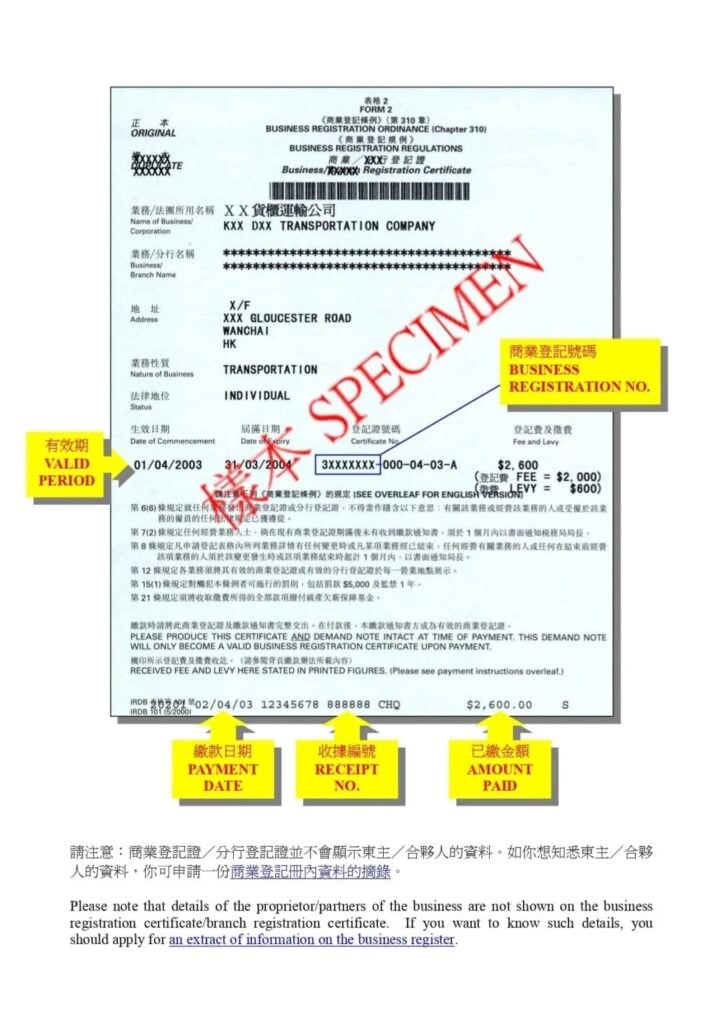
A Business Registration Number (BRN) is the primary business identifier issued by the Inland Revenue Department (IRD) when a business registers under Hong Kong law. It applies to all forms of business operations in Hong Kong, including sole proprietorships, partnerships, branches of overseas companies, and locally incorporated limited companies.
Issuing Authority and Legal Basis
The BRN is issued by the IRD’s Business Registration Office under the Business Registration Ordinance (Cap. 310). This ordinance requires any person or entity carrying on a business in Hong Kong to register with the IRD, regardless of business size or structure. Once registration is completed, the IRD assigns a BRN to identify the business for statutory and administrative purposes.
BRN Format and Where to Find It
A Hong Kong BRN consists of an 8-digit number and forms part of the certificate number shown on the Business Registration Certificate (BRC). The BRN is typically displayed prominently on the certificate, usually near the “Certificate No.” or “Business Registration Number” section.
| Item | Description |
| Number length | 8 digits |
| Issued by | Inland Revenue Department |
| Appears on | Business Registration Certificate |
| Renewal | Required annually or every three years |
Businesses are required to display the BRN on key business documents, including invoices, receipts, and official correspondence.
Role of the BRN in Tax and Daily Operations
The Business Registration Number (BRN) is the reference number used by the Inland Revenue Department (IRD) to track a business’s tax filings, assess tax liabilities, and issue official correspondence. In practice, the BRN is commonly required when:
- Filing Profits Tax Returns and Employer’s Returns
- Communicating with government departments
- Opening and maintaining bank accounts
- Entering into commercial contracts or lease agreements
For most businesses, the BRN functions as the main operational identifier in Hong Kong and is displayed on the Business Registration Certificate (BRC). The requirement to obtain a BRN applies broadly to any person or entity carrying on business in Hong Kong, including sole proprietorships, partnerships, incorporated companies, overseas branches, funds, and representative offices. Statutory exemptions are limited and rarely apply to companies, even if they are dormant or not yet trading.
What Is A Company Registration Number (CRN) In Hong Kong?
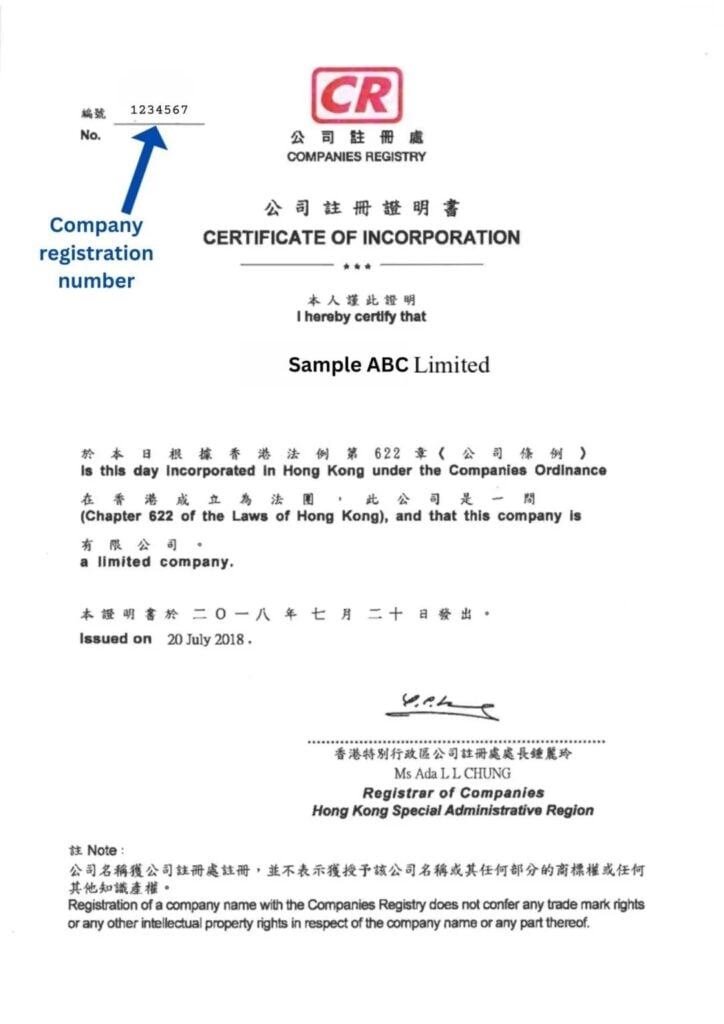
A Company Registration Number (CRN) is a unique 7-digit identifier issued by the Hong Kong Companies Registry when a company is successfully incorporated. It applies only to entities registered as companies under Hong Kong law, such as private and public limited companies. Sole proprietorships and partnerships do not receive a CRN because they are not incorporated entities.
Legal basis under the Companies Ordinance (Cap. 622)
The CRN is governed by the Companies Ordinance (Cap. 622). Once issued, it becomes the company’s permanent reference number within the Companies Registry system. The number does not expire and remains attached to the company throughout its lifecycle, from incorporation to dissolution.
From a legal perspective, the issuance of a CRN confirms that the company has been duly incorporated in accordance with statutory requirements under Hong Kong company law.
CRN format and where it appears
The CRN consists of seven digits and is displayed on key statutory records, including:
- The Certificate of Incorporation issued by the Companies Registry
- The company’s public profile in the Companies Registry search records
- Official Companies Registry filings, such as annual returns and notices of changes
Banks, investors, and professional counterparties often request the CRN to verify a company’s registry status and incorporation details.
CRN as proof of incorporation and separate legal personality
The CRN serves as formal proof that a business is incorporated as a separate legal entity, distinct from its shareholders and directors. This separate legal personality is what enables a Hong Kong company to:
- Enter into contracts in its own name
- Own assets and incur liabilities independently
- Benefit from limited liability protection for its owners
While the CRN establishes corporate existence under company law, it is primarily used for Companies Registry filings and corporate governance matters, rather than tax administration. For day-to-day tax and operational dealings, the Business Registration Number plays a more prominent role.
Difference Between Business Registration Number and Company Registration Number
| Aspect | Business Registration Number (BRN) | Company Registration Number (CRN) |
| Core function | Identifies a business for tax purposes and regulatory administration | Confirms legal recognition of a company as an incorporated entity |
| Issuing authority | Inland Revenue Department (Business Registration Office) | Companies Registry |
| Governing legislation | Business Registration Ordinance (Cap. 310) | Companies Ordinance (Cap. 622) |
| Legal nature | Does not create a separate legal entity | Establishes a separate legal personality |
| Applicability | All businesses carrying on activities in Hong Kong, including sole proprietorships, partnerships, and companies | Companies incorporated or registered under the Companies Ordinance only |
| Role in taxation | Primary identifier for profits tax, salaries tax, and IRD correspondence | Not used as the main tax identifier |
| Use in government filings | Required for tax returns, licence applications, and IRD communications | Required for statutory filings with the Companies Registry |
| Public record function | Confirms a business is registered and recognised by the IRD | Enables public search of company particulars and statutory records |
| Banking and commercial use | Commonly requested for bank account opening, invoicing, leases, and vendor onboarding | Used for corporate due diligence and formal contractual documentation |
| Renewal requirements | Business Registration Certificate must be renewed annually or every three years | No renewal required once issued |
| Compliance focus | Ongoing business operation and tax compliance | Corporate governance, disclosure, and company law compliance |
| Liability implications | Does not affect liability exposure | Signals limited liability where applicable |
| Daily operational relevance | Frequently used in day-to-day business operations | Mainly used for corporate and legal formalities |
Read more: Hong Kong Business Registration Certificate Guide 2026
Unique Business Identifier (UBI) in Hong Kong
Hong Kong introduced the Unique Business Identifier (UBI) regime on 27 December 2023 as part of a broader government initiative to streamline business identification across public systems. Under this reform, the 8-digit Business Registration Number (BRN) issued by the Inland Revenue Department is adopted as the single, unified identifier for companies and certain entities when dealing with government departments.
This change applies to both newly incorporated companies and existing entities registered with the Companies Registry, marking a significant shift away from the traditional reliance on the Company Registration Number (CRN) as the primary external identifier.
The main policy objective of the UBI regime is to eliminate duplication and reduce administrative friction caused by multiple registration numbers. Previously, companies often had to reference both the BRN and CRN when interacting with different authorities, leading to confusion, inconsistent records, and higher compliance risk.
With the UBI framework:
- The BRN becomes the single reference point for cross-departmental identification
- Government data matching and verification are simplified
- Businesses can expect more consistent use of identifiers in filings, searches, and official communications
This reform reflects Hong Kong’s move toward more integrated digital governance and improved regulatory efficiency.
Alignment between IRD and Companies Registry systems
Under the UBI system, the IRD and the Companies Registry are aligned on a shared identifier, using the BRN as the common reference across their platforms. In practical terms:
- For companies incorporated or registered on or after 27 December 2023, the BRN is displayed as the “No.” on the Certificate of Incorporation or Certificate of Registration of Non-Hong Kong Company
- The BRN is used for specified filings and searches within the Companies Registry’s electronic services
- The CRN is no longer the primary outward-facing identifier, although it may still exist within legacy records
For businesses, this means the BRN now plays a dual role, supporting tax administration through the IRD and corporate identification within the Companies Registry system. Understanding this alignment is essential to ensure correct use of identifiers in filings, compliance documentation, and communications with government authorities.
Read more: How does Unique Business Identifier (UBI) impact HK companies?
Validity, Renewal and Compliance Obligations
The BRN itself does not expire, but the Business Registration Certificate linked to it must be renewed annually or every three years. Failure to renew the certificate results in non-compliance, even though the BRN remains unchanged.
In contrast, the CRN is permanent and does not require renewal. It remains attached to the company until formal deregistration or winding up.
Businesses must also notify the Inland Revenue Department within one month of changes to business name, address, nature of business, or cessation of operations. Failure to do so may result in fines, surcharges, or compliance complications with banks and regulators.
Compliance Mistakes Hong Kong Businesses Should Avoid
Despite clear regulatory frameworks, many Hong Kong businesses still make avoidable compliance mistakes around the use of BRN, CRN, and UBI. These errors can lead to filing delays, rejected applications, penalties, or unnecessary follow-ups from regulators and banks. Below are the most common pitfalls to watch out for, especially after the introduction of the UBI regime.
1. Treating BRN, CRN, and UBI as Interchangeable
One of the most frequent mistakes is assuming that the Business Registration Number (BRN), Company Registration Number (CRN), and Unique Business Identifier (UBI) serve the same function.
They support different compliance areas:
- BRN is issued under the Business Registration Ordinance and is primarily used for tax administration, IRD correspondence, licensing, banking, and daily operations.
- CRN was historically used to identify a company under the Companies Ordinance for statutory filings and public records.
- UBI uses the BRN as the single identifier for entities under the Companies Registry.
Using the wrong identifier can result in rejected submissions or requests for clarification, particularly when dealing with government departments or financial institutions.
2. Using an Outdated CRN Where UBI Is Required
Since the implementation of the UBI regime, many Companies Registry forms and electronic search functions now require the BRN (as UBI) instead of the traditional CRN.
Common issues include:
- Submitting Companies Registry forms with the old CRN instead of the BRN
- Searching company records using CRN where the system now prioritises UBI
- Providing CRN to third parties who explicitly request a UBI
For companies incorporated or registered on or after 27 December 2023, the BRN is also displayed as the “No.” on the Certificate of Incorporation or Certificate of Registration of Non-Hong Kong Company. Continuing to rely solely on the CRN can cause confusion and slow down compliance processes.
3. Missing Business Registration Certificate Renewals
Another common compliance failure is overlooking the renewal of the Business Registration Certificate (BRC).
Key points to remember:
- The BRN itself does not expire, but the BRC must be renewed annually or every three years, depending on the certificate option chosen
- Operating with an expired BRC can lead to surcharges, fines, and regulatory scrutiny
- Renewal notices are issued by the IRD, but responsibility ultimately rests with the business owner or directors
This mistake is especially common among dormant companies or holding entities that assume no renewal is required because there is no active trading.
4. Incorrect Identifiers in Banking or Regulatory Submissions
Banks, regulators, and service providers in Hong Kong often request specific identifiers depending on the context. Providing the wrong number can delay onboarding, compliance reviews, or transaction approvals.
Typical examples include:
- Using a CRN instead of a BRN for bank account opening or KYC updates
- Quoting a BRN where a Companies Registry filing specifically requires a company identifier under the UBI system
- Inconsistent use of identifiers across tax filings, invoices, contracts, and statutory documents
To reduce risk, businesses should maintain clear internal records showing where each identifier is used and ensure staff and service providers apply the correct number for each submission.
Common Mistakes and How to Avoid Them
| Compliance Issue | Common Error | Best Practice |
| Identifier usage | Treating BRN, CRN, and UBI as the same | Match the identifier to the regulator and purpose |
| UBI regime | Using CRN instead of BRN | Use BRN as UBI for Companies Registry matters |
| BRC renewal | Missing renewal deadlines | Track annual or triennial renewal dates |
| Banking & filings | Providing the wrong number | Confirm which identifier is required before submission |
Avoiding these issues helps maintain smooth compliance, reduces administrative back-and-forth, and protects your company’s credibility with regulators, banks, and business partners.
Best Practices For Managing Business Identifiers
Proper management of business identifiers is an essential part of Hong Kong corporate compliance. With BRN, CRN, and now UBI in use, adopting clear internal practices helps reduce regulatory risk, avoid administrative errors, and ensure smoother interactions with authorities and third parties.
1. Keep Records Consistent
All statutory and registration records should reflect the same identifiers across documents and systems. Inconsistencies between BRN, CRN, and UBI details often trigger follow-up queries from regulators, banks, or auditors.
As a best practice, ensure that:
- The BRN on tax filings, licences, invoices, and bank records matches the Business Registration Certificate
- The CRN (for older companies) aligns with historical Companies Registry filings
- Internal databases and compliance trackers clearly note that the BRN now serves as the UBI
Regular internal reviews help catch discrepancies early, especially after changes such as company name updates or reorganisation.
2. Set Clear Internal Controls
Strong internal controls reduce reliance on memory or ad hoc handling of compliance documents. Businesses should establish simple but effective procedures for managing identifiers.
This may include:
- Maintaining a central compliance file with the latest BRC, Certificate of Incorporation, and key filings
- Using standard templates for contracts and invoices that reference the correct identifier
- Assigning responsibility to a specific team member for tracking renewals and regulatory deadlines
Clear controls are particularly important for SMEs and fast-growing companies where compliance tasks are often shared across teams.
3. Align with Banks and Advisors
Banks, auditors, payroll providers, and other service firms may request different identifiers depending on the purpose and timing of incorporation. Proactive coordination avoids delays and repeated document requests.
This means:
- Confirming whether a bank or counterparty requires BRN, CRN, or UBI before submission
- Providing supporting certificates when identifiers appear different due to the UBI transition
- Keeping advisers informed of any changes to registration details
Many institutions now treat the BRN as the default corporate identifier, but legacy systems may still reference the CRN for older companies.
4. Engage Company Secretarial Support
Professional company secretarial support becomes advisable when compliance obligations increase or internal resources are limited. This is especially relevant for:
- Companies with multiple entities or cross-border structures
- Businesses operating in regulated sectors
- Overseas owners unfamiliar with Hong Kong compliance practices
- Companies navigating the UBI transition alongside ongoing filings
A qualified company secretary helps ensure identifiers are used correctly across filings, renewals, and communications, reducing the risk of errors that could lead to penalties or operational disruption.
Why Professional Support Matters
Using the wrong identifier at the wrong time is a common but avoidable compliance risk in Hong Kong. Confusing the BRN with the CRN, or failing to reflect the BRN correctly under the UBI regime, can lead to rejected filings, delays in bank onboarding, inconsistent public records, or unnecessary follow-up from the IRD or Companies Registry. These issues often arise during routine events such as tax filings, annual returns, licence applications, or when third parties conduct due diligence. Over time, small identifier errors can escalate into regulatory exposure, penalties, or reputational concerns.
Professional company secretarial support helps businesses manage these risks by ensuring that BRN, CRN, and UBI details are correctly applied across all filings and renewals. A qualified company secretary monitors renewal deadlines, aligns records between the IRD and Companies Registry, and ensures that information provided to banks, auditors, and counterparties is consistent and up to date. This level of coordination is particularly important for growing companies, groups with multiple entities, and overseas owners navigating Hong Kong’s evolving compliance landscape.
Conclusion
Understanding the difference between the Business Registration Number, Company Registration Number, and the new Unique Business Identifier is now a core compliance requirement for Hong Kong businesses. The BRN governs tax administration and daily operations, the CRN establishes legal identity under company law, and under the UBI regime, the BRN has become the primary identifier across most government interactions. Correct usage of each identifier is no longer just an administrative detail. In a post-UBI environment, it directly affects filings, public records, banking, licensing, and third-party due diligence. For Hong Kong businesses, maintaining accuracy and consistency across these identifiers is essential to avoid compliance risks and operational disruption.
How FastLane Group Can Help
FastLane Group supports Hong Kong businesses at every stage of incorporation, registration, and ongoing compliance. Our licensed company secretarial team helps ensure your BRN, CRN, and UBI details are correctly issued and aligned across the Inland Revenue Department, Companies Registry, and third parties such as banks and auditors. Whether you are incorporating a new company or managing renewals, we provide support without overpromising. Contact us today to keep your Hong Kong business structured.