Malaysia is undergoing a major digital transformation in its tax administration. E-Invoicing is no longer just a digital convenience; it’s becoming a legal requirement in Malaysia. With the Inland Revenue Board of Malaysia (IRBM/LHDN) rolling out its national e-Invoicing initiative, all businesses, whether small, medium, or large, must adopt electronic invoicing to remain compliant.
For Malaysian businesses, this means moving away from manual or email-based invoices and embracing a secure, standardized system through the Peppol network. While compliance may sound challenging, solutions like Xero make the transition smooth, helping businesses stay compliant while improving efficiency.
In this guide, we’ll break down what you need to know about e-Invoicing in Malaysia, important deadlines, Peppol compliance requirements, and how FastLane Group and Xero can help you simplify compliance.
Key Summary
What is E-Invoicing?
E-Invoicing is the digital process of creating, transmitting, and storing invoices in a structured format. In Malaysia, it ensures standardized reporting, reduces errors and fraud, and speeds up payments.
Who Needs to Comply?
All businesses operating in Malaysia must adopt e-Invoicing, with compliance deadlines based on annual turnover. Early preparation is recommended, even for later phases.
Understanding Peppol Compliance
Peppol is a global network for secure and standardized invoice exchange. Businesses must use certified providers like Xero, follow the Peppol BIS 3.0 format, and integrate with the MyInvois portal to validate invoices with IRBM. MDEC acts as Malaysia’s Peppol Authority, accrediting local Peppol service providers and setting national requirements.
Benefits of E-Invoicing and Peppol Compliance
E-Invoicing improves business efficiency by enabling faster payments, reducing costs, improving accuracy, supporting global trade, and simplifying compliance with IRBM and MDEC requirements.
What is Xero?
Xero is a cloud-based accounting platform and certified Peppol service provider in Malaysia. It automates invoice creation, validation, and submission, reducing admin workload and ensuring compliance.
How Xero Simplifies Compliance
Xero’s built-in Peppol connectivity, automated compliance checks, and scalable solutions let businesses issue compliant e-Invoices effortlessly. It eliminates manual uploads and ensures accurate reporting to MyInvois.
Tips to Prepare for E-Invoicing
Register early with MyInvois, choose a certified provider like Xero, audit invoices and customer data, train your finance team, and leverage automation to reduce errors and save time.
FastLane Group Support
FastLane Group, a Xero Platinum Champion Partner, helps Malaysian businesses implement, customize, and optimize Xero for e-Invoicing and Peppol compliance. Our team ensures your business stays compliant, efficient, and ready to scale.
What is e-Invoicing?
E-Invoicing is the process of generating, transmitting, and storing invoices in a structured digital format. Unlike traditional invoices, e-Invoices can be validated automatically and exchanged securely between businesses and government systems.
In Malaysia, the government has introduced e-Invoicing to:
- Standardize invoice reporting for consistent tax compliance.
- Cut down on human errors—like typos, double entries, or missing information.
- Reduce fraud by ensuring every invoice goes through the official Inland Revenue Board of Malaysia (IRBM/LHDN) system.
- Speed up payments, since e-Invoices are validated almost instantly.
- Improve record-keeping for businesses by keeping everything digital and centralized.
Example: If a retail store in Kuala Lumpur invoices a supplier for RM10,000 worth of goods, the invoice generated in Xero is sent through Peppol, validated by MyInvois, and only then delivered to the supplier. This ensures both the supplier and IRBM have the same accurate record of the transaction.
Learn more from LHDN’s official e-Invoicing guidelines.
Who Needs to Comply with e-Invoicing?
The e-Invoicing mandate applies to all businesses operating in Malaysia, regardless of size or industry. Compliance deadlines are based on annual turnover thresholds.
| Annual Revenue (MYR) | Mandatory Start Date | Relaxation Period Ends | Notes |
| ≥ RM100 million | 1 August 2024 | 31 January 2025 | First wave of adoption |
| RM25M – RM100M | 1 January 2025 | 30 June 2025 | Second phase rollout |
| RM5M – RM25M | 1 July 2025 | 31 December 2025 | SME phase |
| RM1M – RM5M | 1 January 2026 | 30 June 2026 | Fourth phase |
| Up to RM1M | 1 July 2026 | 31 December 2026 | Final rollout |
| Below RM500K (MSME) | Exempt | — | If not part of a related group |
From 1 January 2026, any single transaction above RM10,000 must be issued as an individual e-invoice (not consolidated).
Also Read: Simplify e-Invoicing Compliance in Malaysia with Xero
Why phased implementation?
This approach gives larger companies (with more resources) less time, while smaller businesses get additional breathing room. For example, a local cafe with RM700,000 annual turnover must comply by 1 July 2025, while a neighborhood freelancer with RM200,000 turnover only needs to comply by 1 January 2026.
Tip for businesses: Even if your compliance date is far away, don’t wait until the last minute. Early adoption lets you:
- Test the system without pressure.
- Train your finance team before it becomes mandatory.
- Avoid costly mistakes when deadlines arrive.
Peppol Compliance in Malaysia
To ensure interoperability and security, Malaysia has mandated the use of the Peppol network for e-Invoicing. Think of Peppol as a global digital highway for invoices. Instead of sending invoices by email (where formats differ, attachments get lost, or fraud risks are higher), Peppol ensures all invoices are sent in one secure, standardized way.
In Malaysia, Peppol is managed by the Malaysia Digital Economy Corporation (MDEC), which oversees how businesses connect to the network. This setup allows invoices to flow seamlessly, not just within Malaysia, but also with international trade partners who already use Peppol.
Also Read: Customizing Xero for Your Business: Expert Setup Training
What Does Peppol Compliance Mean?
For your business, being Peppol-compliant means three main things:
- Use a certified Peppol Service Provider (SP) or Access Point (AP)
You can’t just log into Peppol directly. Instead, you work with a certified provider (like Xero) that connects your business to the network. They handle the technical side, so you don’t need to build anything from scratch.
Example: A logistics company in Penang generates an invoice in Xero. Xero, acting as the Peppol Service Provider, automatically sends it into the network in the correct format. - Follow the Peppol BIS Billing 3.0 format
This is the standardized “recipe” for creating e-Invoices. It ensures that when you send an invoice, the recipient’s system (and IRBM’s system) can read it without confusion.
Think of it like submitting a form online. If everyone fills in the same boxes (e.g., buyer, seller, tax ID, amount, description), no critical information gets lost. - Connect with the MyInvois Portal (IRBM’s system)
Every e-Invoice must pass through the government’s MyInvois portal. This is where invoices are validated and officially recorded for tax compliance. Once validated, the invoice is forwarded to your customer.
Example: A supplier in Johor sends an invoice through Xero → Peppol → MyInvois. IRBM validates the invoice and then passes it to the customer, ensuring everyone (supplier, customer, and tax authority) sees the same version.
| Compliance Requirement | What Businesses Must Do |
| Register with IRBM | Businesses must register via the MyInvois system. |
| Use Peppol Standards | Ensure invoices are generated in Peppol BIS 3.0 format. |
| Access via Service Providers | Work with a certified Peppol provider like Xero. |
| Integration with MyInvois | All transactions are automatically validated and reported to IRBM. |
For more details, visit MDEC’s Peppol resources.
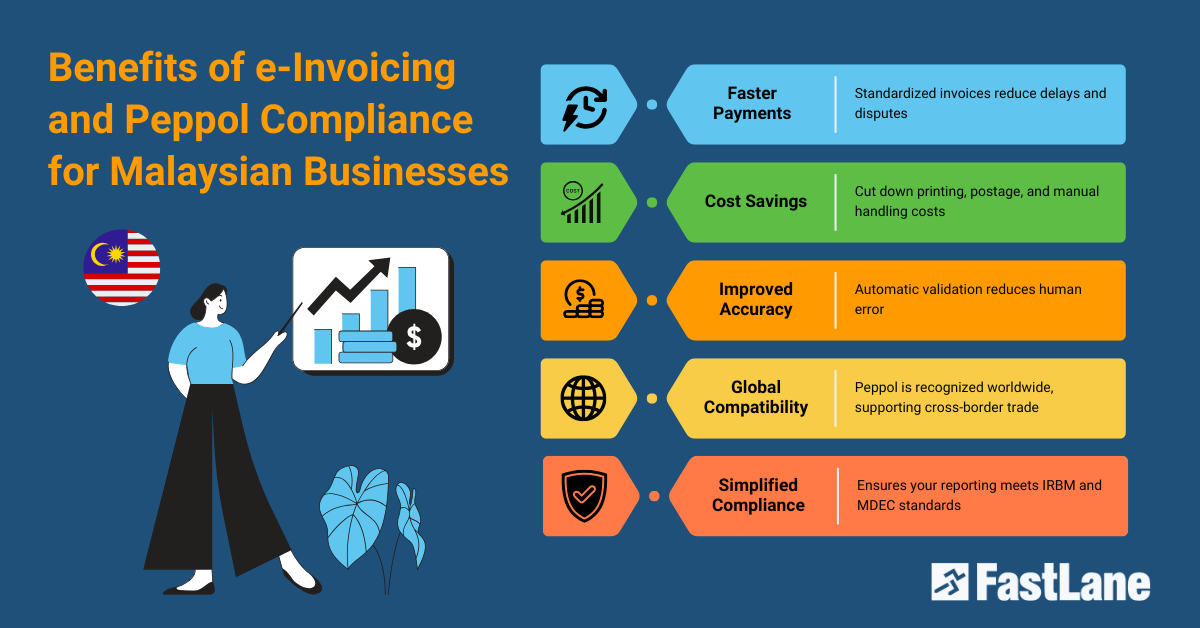
Benefits of e-Invoicing and Peppol Compliance for Malaysian Businesses
While following the rules is mandatory, adopting e-Invoicing with Peppol isn’t just about compliance. It actually makes running your business smoother, cheaper, and more competitive in the long run. Here’s how:
Faster Payments
With standardized invoices that flow directly through the Peppol network and MyInvois, there’s less back-and-forth over missing details or incorrect formats. This means your customers can approve and pay invoices quickly.
Example: Instead of waiting weeks because a client claims they “didn’t receive your invoice” or “the amount didn’t match,” e-Invoices are validated upfront, ensuring smoother cash flow.
Cost Savings
Stop printing stacks of invoices, posting them, or manually keying them into spreadsheets. E-Invoicing cuts down on paper, postage, and administrative tasks, saving both time and money.
Example: An SME that issues 500 invoices a month can save thousands annually by eliminating printing and mailing costs alone.
Improved Accuracy
Every e-Invoice is validated against IRBM’s rules before it reaches your customer. This means fewer mistakes, reduced risk of duplicate invoices, and fewer rejected claims.
Example: If you accidentally enter the wrong tax code, MyInvois flags it instantly, before it causes reporting issues or disputes.
Global Compatibility
Peppol isn’t just a Malaysian system; it’s a global standard used in Europe, Singapore, Australia, and many other regions. By joining the network now, your business is ready for cross-border trade without needing to reformat invoices for different countries.
Example: A Malaysian exporter sending goods to Singapore can issue a Peppol e-Invoice in Xero that’s instantly accepted in Singapore’s system without extra conversion.
Also Read: How Xero Health Check Can Save Your Business Time and Money
Simplified Compliance
Instead of scrambling to prepare manual tax records for IRBM, e-Invoicing automatically feeds validated data into the system. This reduces audit risks and ensures you stay compliant with both IRBM and MDEC requirements.
Example: During tax season, businesses no longer need to dig through piles of paper invoices, everything is already validated and recorded digitally.
While compliance is mandatory, e-Invoicing with Peppol also brings significant benefits:
| Benefit | What it Means for Your Business |
| Faster Payments | Standardized invoices reduce delays and disputes. |
| Cost Savings | Cut down printing, postage, and manual handling costs. |
| Improved Accuracy | Automatic validation reduces human error. |
| Global Compatibility | Peppol is recognized worldwide, supporting cross-border trade. |
| Simplified Compliance | Ensures your reporting meets IRBM and MDEC standards. |
How Xero Simplifies e-Invoicing and Peppol Compliance
What is Xero?
Xero is a cloud-based accounting software designed for small and medium-sized businesses. It helps manage bookkeeping, payroll, invoicing, and reporting — all in one place, accessible from anywhere. Xero is a certified Peppol Service Provider for Malaysia (via Tickstar) and integrates directly with MyInvois for invoice validation. This means it meets all technical and legal requirements to help businesses comply with LHDN’s e-Invoicing mandate.
Think of Xero as your all-in-one financial hub: it keeps your accounts up to date, ensures invoices are compliant, and handles the Peppol connection behind the scenes so you don’t have to.
Built-in Peppol Connectivity
Because Xero is Peppol-ready, you don’t need to set up complicated integrations or deal with third-party tools. You can send and receive e-Invoices directly from Xero, and they will automatically pass through the Peppol network and MyInvois.
Example: A retail shop in Kuala Lumpur issues an invoice in Xero. Instead of exporting it and manually uploading it to MyInvois, Xero automatically sends it through Peppol to the customer and IRBM.
Also Read: Why Regular Xero Health Checks Are Essential
Automated Compliance
One of the biggest worries for businesses is whether their invoices meet IRBM’s strict formatting rules. Xero takes care of this by automatically formatting invoices in the Peppol BIS 3.0 standard. It also ensures every invoice is reported to MyInvois, so you stay compliant without extra effort.
This means you don’t need to double-check if you’re using the right codes, tax fields, or formats, Xero does it for you.
Less Admin, More Efficiency
Manual uploads and re-entry of invoices waste time and increase the risk of errors. With Xero, you create an invoice once, and the system handles the validation and submission in the background.
Example: An SME that previously spent hours each week uploading invoices to MyInvois can now create invoices directly in Xero and let the system handle the rest. This frees up staff to focus on sales, customer service, or operations instead.
Scalable Solution for Any Business
Whether you’re a small café issuing a few invoices per week or a manufacturing company sending hundreds of invoices daily, Xero adapts to your needs. As your business grows, Xero grows with you, supporting more users, more invoices, and more integrations without losing compliance.
Why This Matters
Instead of logging into the MyInvois portal every single time you issue an invoice, Xero automates the entire process. You get the peace of mind that your invoices are Peppol-compliant, IRBM-validated, and securely delivered to your customers without extra work.
Also Read: Xero Migration & Setup with FastLane Xero Platinum Partner
Tips to Prepare for e-Invoicing & Peppol Compliance
1. Register Early with MyInvois
Registering on the MyInvois portal early gives your business a head start. When deadlines get closer, thousands of companies will try to register at the same time, which can slow things down. Getting it done now ensures you have plenty of time to test the system and sort out any issues before e-Invoicing becomes compulsory.
Example: If your business turnover is RM25 million, your deadline is January 2025, but registering in late 2024 could mean competing with thousands of others doing the same. Early registration avoids the rush.
2. Choose a Certified Provider Like Xero
To comply with Peppol, you’ll need a certified Service Provider (SP) or Access Point (AP). Choosing a provider like Xero ensures that your invoices are automatically formatted in the required Peppol BIS 3.0 standard and properly reported to MyInvois. This saves you from manual formatting and reduces compliance risks.
Think of it like hiring a licensed courier; you know your invoices will always be delivered to the right place, in the right format.
3. Audit Your Invoices and Customer Data
Before switching to e-Invoicing, review your existing invoice templates and customer records. Check that your invoices include all required fields (like company registration number, tax ID, and payment details) and that your customer data is clean and up to date.
Example: If you have customers listed without proper tax identification numbers, your e-Invoices may be rejected by MyInvois. Cleaning up data early avoids interruptions later.
| Audit Area | What to Check |
| Customer Records | Valid business registration numbers, tax IDs, and Peppol identifiers |
| Invoice Templates | Alignment with Peppol XML schema and IRBM requirements |
| Tax Treatment | Correct SST codes and exemptions applied |
4. Train Your Finance Team
E-Invoicing changes the way invoices are created, validated, and reported. Make sure your finance team understands the new workflows, deadlines, and system requirements. Training sessions can prevent mistakes and ensure smoother adoption.
Example: A finance officer who is used to emailing PDF invoices will need to know how to generate and send e-Invoices directly through Xero instead. Clear training prevents confusion.
5. Leverage Automations in Xero
One of the biggest advantages of using Xero is automation. Instead of manually uploading invoices or worrying about compliance rules, Xero handles the background tasks for you. By taking full advantage of these features, you can reduce admin work, minimize errors, and focus more on growing your business.
Example: With Xero, an invoice issued today is automatically validated and reported to IRBM without your team needing to lift a finger. This means fewer delays and faster payments.
Also Read: How To Connect RHB To Xero
Frequently Asked Questions
Why has Malaysia chosen Peppol for e-Invoicing?
Peppol provides a secure, standardized framework that ensures global interoperability and reduces fraud risks.
How do I check if a business is Peppol-registered?
You can check through the official MDEC directory of Peppol participants.
Can I use Xero for e-Invoicing?
Yes. Xero supports e-Invoicing for Malaysian businesses and is fully integrated with Peppol.
How do I know if a business is registered for e-Invoicing?
You can check registration status via the MyInvois portal.
Conclusion
Malaysia’s shift to mandatory e-Invoicing and Peppol compliance is part of a broader digital transformation initiative. While adapting to these new requirements may seem complex, tools like Xero make compliance simple, efficient, and scalable.
At FastLane Group, we help businesses not just comply but thrive. As a Xero Platinum Champion Partner, we support Malaysian companies with the setup, integration, and ongoing optimization of Xero for e-Invoicing and Peppol compliance.
Also Read: The Top 5 Common Mistakes in Xero Setup and How Our Training Can Help You Avoid Them
Ready to Simplify Your E-Invoicing Journey?
Malaysia’s move toward mandatory e-Invoicing and Peppol compliance doesn’t have to be overwhelming. With the right partner and the right tools, staying compliant can actually become an opportunity to streamline your operations and future-proof your business.
At FastLane Group, we make compliance simple, seamless, and scalable with Xero, the world’s leading cloud accounting platform. As a Xero Platinum Champion Partner, winner of the Xero Accounting Partner of the Year Hong Kong 2019, Xero Asia Advisory Partner of the Year 2024 and the Total Xero Award 2025, we’re trusted across the region for helping businesses modernize their financial management.
Whether you’re a startup preparing for growth, an SME looking to save time and reduce admin, or a large enterprise needing scalable solutions, our team of Xero Certified Advisors will:
- Set up Xero tailored to your business workflows.
- Ensure your invoices meet Peppol BIS 3.0 standards and are validated automatically via MyInvois.
- Train your team so they’re confident in managing e-Invoicing.
- Leverage automation to minimize compliance risks while maximizing efficiency.
Instead of navigating portals manually, let FastLane and Xero handle the heavy lifting so you can focus on running your business, not chasing compliance deadlines.
Contact FastLane Group today to discover how our Xero solutions can help your Malaysian business stay compliant, save time, and scale with confidence.